Apple Slump: an American Tragicomedy
Louisa May Alcott, author of Little Women, housed and fed three generations of her family—shored up the walls and filled the pantry with her words—and she did it with fierce determination and ironic wit.

“Give me one day of practical philosophy; it is worth a century of speculation and discussion." —Abigail Alcott
"I can't afford to starve on praise when rubbishy tales are written in half the time." —Louisa May Alcott
Things fall apart—by mishap, mischief, or plain old entropy. Fancy as we are with our fine minds and yearning hearts, we're still fragile, featherless bipeds; we can't just fly away and re-roost when the chimney threatens to fall in. (This metaphor is brought to you by the men who were mortaring bricks outside my window last week so that said bricks wouldn't fall on our heads.)
But there's nothing to say we can't have a laugh at this messy, awkward business of survival. Louisa May Alcott, author of Little Women, housed and fed three generations of her family—shored up the walls and filled the pantry with her words—and she did it with fierce determination and ironic wit.
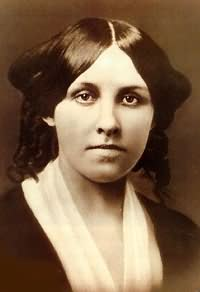
Alongside her mother and three sisters, Louisa struggled through decades of poverty because their physical well-being took a backseat to her father's ideals. Her mother, Abigail, had grown up in wealth and comfort but then fell in love with Bronson Alcott, a visionary philosopher and teacher. Abigail did her best to serve as ballast for Bronson's dreams and to keep her "cubs" (Louisa and her three sisters) fed.
Bronson was a pioneer of progressive education and transcendentalism, a philosophical movement that inspired many communes in the mid-1800s. I wrote about the Transcendentalists last year while checking out present-day intentional communities. What I didn't know at the time was the connection to the Alcotts, who were close friends and neighbors of Ralph Waldo Emerson, Nathaniel Hawthorne, and Henry David Thoreau. Emerson showed many kindnesses to the family and rescued them from destitution more than once.
In 1843, when Louisa was 10, her father co-founded a commune called Fruitlands. It was an experiment in spartan, virtuous living: they would farm the land, eat no animal products, and even avoid yoking animals to the plow. Bronson piled his young family into a cart along with his treasured bust of Socrates, deposited them all in a dilapidated farmhouse, and collected an odd assortment of recruits to fulfill his vision. All of them had lofty ideals but not the foggiest notion how to farm. Louisa's mother picked up the slack, performing most of the household work and much of the farm labor as her husband and his disciples traipsed around lecturing their bewildered neighbors.
They preached vegetarianism everywhere and resisted all temptations of the flesh, contentedly eating apples and bread at well-spread tables, and much afflicting hospitable hostesses by denouncing their food and taking away their appetites...But, when the perplexed or offended ladies asked what they should eat, they got in reply a bill of fare consisting of “bowls of sunrise for breakfast,” “solar seeds of the sphere,” “dishes from Plutarch’s chaste table,” and other viands equally hard to find in any modern market. —Louisa May Alcott, "Transcendental Wild Oats"
Emerson admired Bronson's ideas, hailing him as "the most refined and advanced soul we have had in New-England, who makes all other souls appear slow and cheap and mechanical." However, Emerson also knew the harsh reality of New England winters. After visiting Fruitlands in July, he wrote, “I will not prejudge them successful: They look well in July; we will see them in December.”
That winter they all nearly starved to death.
Thirty years later, Louisa would publish a satirical account of the Fruitlands experiment in an essay titled "Transcendental Wild Oats." She changed only the people's names. In this passage she describes how her mother saved the crop that was to feed them that winter:
About the time the grain was ready to house, some call of the oversoul wafted all the men away. An easterly storm was coming up and the yellow stacks were sure to be ruined. Then Sister Hope gathered her forces. Four little girls, one boy (Timon’s son), and herself, harnessed to clothes-baskets and Russia-linen sheets, were the only teams she could command; but with these poor appliances the indomitable woman got in the grain and saved food for her young, with the instinct and energy of a mother-bird with a brood of hungry nestlings to feed.
After Fruitlands, Emerson pitched in $500 to supplement Abigail's inheritance so that the family could buy a house in Concord. They had Emerson and his family across the street, Hawthorne and his brood down the road, and Thoreau (on whom Louisa had a crush) leading romps through the woods. It was the happiest time of Louisa's childhood.
"I had an early run before the dew was off the grass. The moss was like velvet, and I sang for joy." —Concord, 1845
Eventually, with her father off sowing spiritual oats, the family fell into poverty again. Unable to survive in Concord, they ended up living at the edge of a Boston slum. Mother and daughters did every kind of work that respectable women could do. Louisa worked as a governess, seamstress, and companion to an invalid. When the invalid's brother found that the sharp-tongued companion had no patience for his pompous blathering, which she denounced as "philosophical, metaphysical, and sentimental rubbish," he demoted her to a servant and had her hauling coal.
Then Louisa began to sell the adventure stories and pulp thrillers that she had a knack for writing. To support her family, she wrote as fast as her cramping fingers would allow, publishing the trashy tales anonymously. The 1868 novel Little Women, published under her own name, was something else: a story drawn largely from real life, including her own dreams and ambitions and her sister Elizabeth's death from scarlet fever. As one of the first major works of fiction to portray girls' lives authentically, it has resonated with every generation of American girls since.
Louisa became mother to her niece Lulu when her sister May died after childbirth. Alcott herself died just eight years later, within days of her father, to whom she'd become much closer at the end of their lives. Her literary legacy ensured that her family never again had to worry where their next meal was coming from.
Bronson Alcott's legacy, bought with his wife and daughters' anxious labor, was not nothing: he pioneered the Socratic method in American education, denounced the corporal punishment that was standard in schoolhouses, and advocated for kindness and empathy toward children. Emerson's writings might have been very different without Bronson's influence, and I, along with millions of other Americans, might be somebody else without Emerson.
But maybe the real point is that all of us owe a debt of gratitude to Abigail Alcott.
Apple Slump: the Joke and Recipe
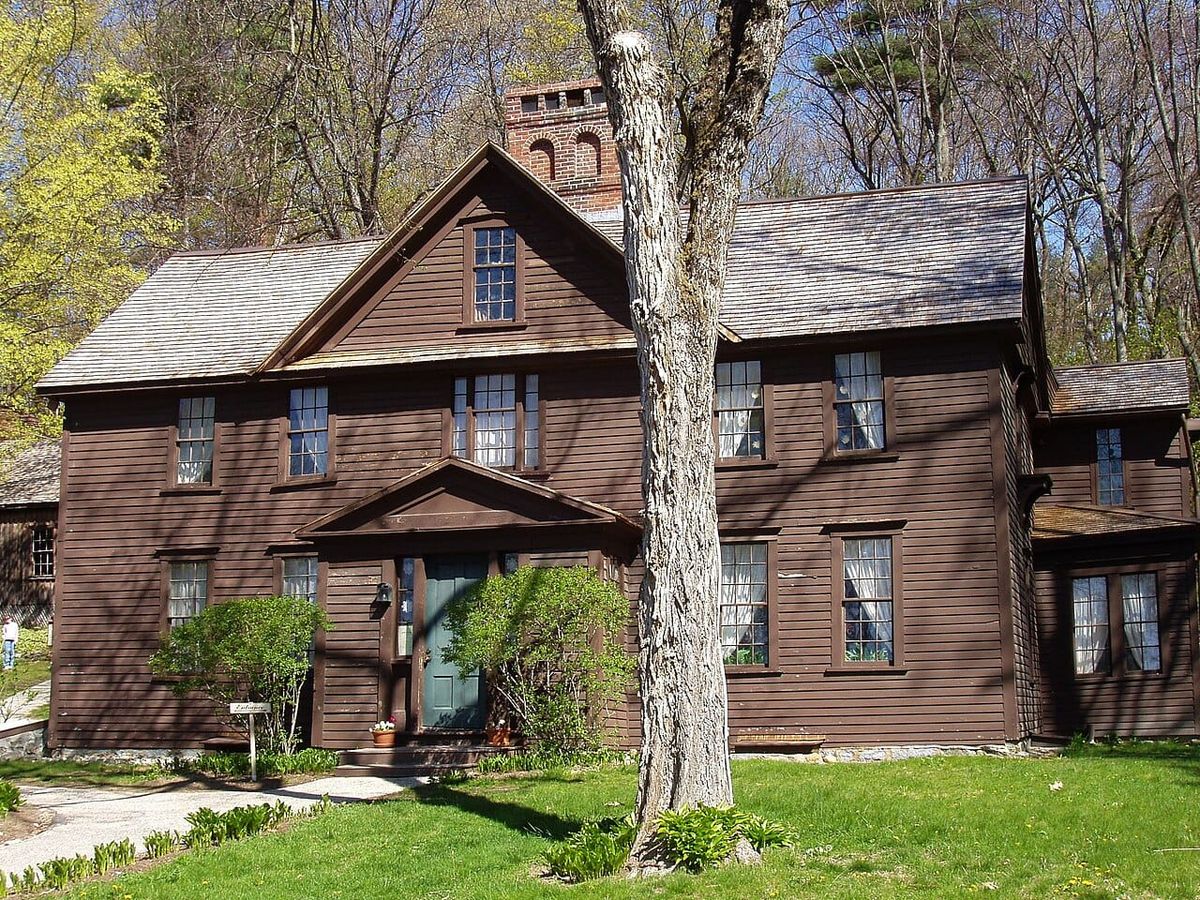
Louisa wrote Little Women at Orchard House, a house that her father bought and repaired in Concord after the war. When Louisa and her mother first saw the ramshackle house, they called it Apple Slump, the name of a popular dessert. In one swoop, they poked good-humored fun at the house's slanted walls and gave an ironic nod back at the Fruitlands debacle.
Louisa wrote "Apple Slump" as her address at the top of a letter in 1860. In that same letter she wrote:
Father continues to stir up the schools like a mild pudding-stick, Mother to sing Hebron among her pots and pans, Anna and the Prince Consort to bill and coo in the little dove-cot...and the old house to put its best foot foremost and hoot at the idea of ever returning to the chaos from which it came.
This is a condensed history of "the pathetic family," which is also a "happy family," owing to the prevalence of friends and lots of kindness in the original packages, "which are always arriving" when the "Widow Cruise's oil-bottle" begins to give out.
We're coming up on fall, the perfect time to bake an Apple Slump in the Alcotts' honor. I've found several variations of the dessert online but no direct source of the recipe that Louisa would have used. To keep things as authentic as possible, here are two versions from a 1907 cookbook.
Apple Slump No. 1 ("steamed dumpling" style)
Pare, core, and quarter a dozen tart, juicy apples and place in a covered saucepan. Pour over them a pint of hot water and set on the back of the stove for eight minutes, then add two cups of molasses. Make a soft biscuit dough with milk, roll it out half an inch thick, and use it as a cover for the apples. Put the lid on tight and cook on top of the stove for thirty minutes without lifting the cover. It may then be set in the oven to brown a few minutes, or served as is, with a sweet sauce.
Apple Slump No. 2 ("baked pudding" style)
Mix one or two eggs into a milk biscuit dough made with a pint and a half of flour, then stir in two quarts of finely cut apples. Spread half an inch thick in a buttered baking pan and bake in a quick oven [a hot oven, roughly 400–450°F]. Eat with cream.