Bread from Ashes
by
Inhinan
Jody Frank
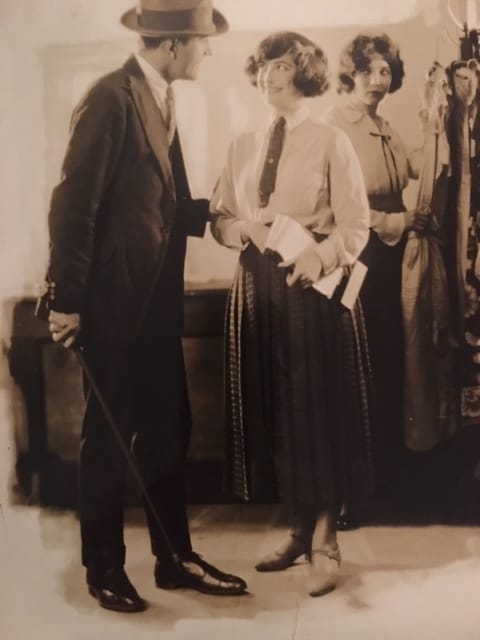
Inhinan is a medical doctor, a lifelong learner and thinker, and one of my favorite people. I'm happy for the chance to share his story with you in his own words. –Jody
I was born in Misrata, a city on the Mediterranean coast of Libya, but I took my first steps in Tripoli where I grew up and spent most of my life. From an early age I was bilingual, speaking Arabic and Tamasheq, the Tuareg language. The two languages embody vastly different ways of being: the expressions and idioms, satirical humor, and body language all are different. So from a young age, I had the blessing of seeing, hearing, and looking at things from different angles.

As the only Tuareg family in the capital of Libya, our home was the first station for all Tuareg from different countries. Some of them lived with us for years, which caused a lot of confusion in the conservative Arab community around us because their culture kept women apart from men outside their families. Unlike most Middle Eastern societies, Tuareg culture is matriarchal and doesn't separate men and women. Most Tuareg men were raised in the desert with a strong moral code of honor called ashaq, which means self-doubt or self-watching. While they can be fierce warriors, they are mostly quite shy around women, hiding their faces under a turban. You would not see a Tuareg man eat in public or show his mouth eating in front of women.
Of course, our language was strange to the people in Tripoli, too, even though Tamasheq is an Indigenous language that was spoken and written all over the South of Libya for centuries before Arab colonization. Ordinary people would be like, "What did I just hear?! What is that language? Say that again!"
The dictator Gaddafi hated anything related to the Amazigh, or Berber people, the large ethnic group of North Africa that we belong to. So he insisted that Libyan Tuaregs were "the Arabs of the Sahara" and tried to divide us from our heritage. The regime had ears everywhere, so, for example, a state employee speaking with a friend in Tamasheq would be asked to speak Arabic instead.
Get new stories in your inbox.
Eventually, we were five Tuareg families in Tripoli and ten in the Libyan cities of Benghazi and Misrata. But most of my people couldn't stand cities, the different culture and urban life. We were strangers who came from a far land called Ténéré, which means "loneliness" in Tamasheq, and that shared origin created a strong bond and selfless ethic among us. Our ancestors had sought freedom in that harsh desert land, ruled only by God and honor. But as immigrants we had to go through an arduous assimilation that sophisticates you. As someone who grew up in the city, I always wondered why my people would leave the lively coastal cities and chose to live and work in distant, bare desert towns. Sometimes I asked them, and I couldn't reason it out when some of them would answer, "These places are close to home."
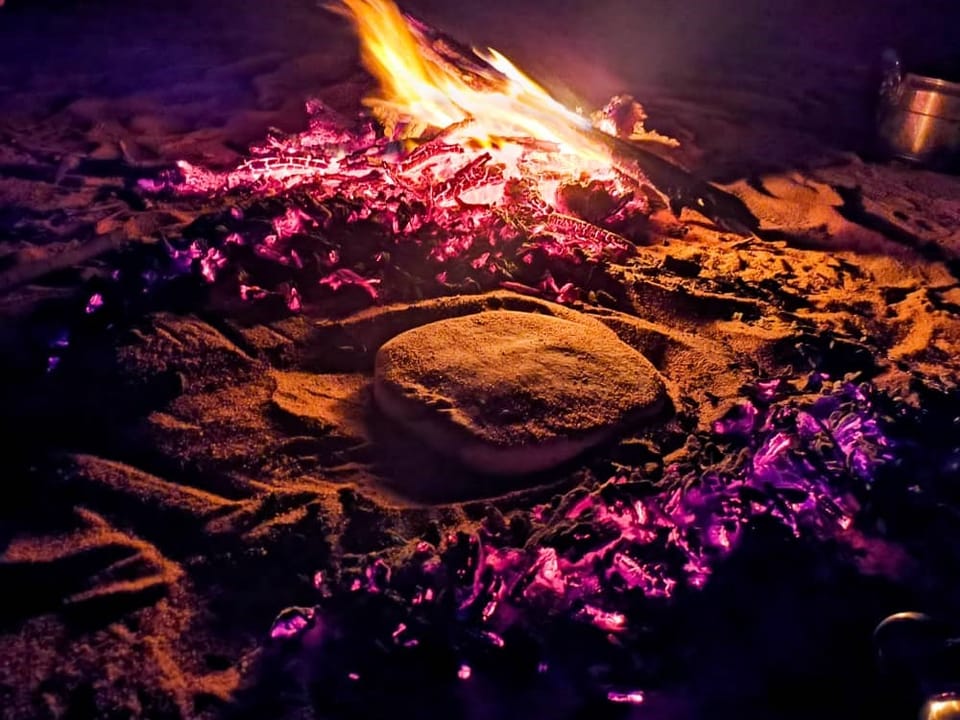
You may wonder how my family came to be strangers in a strange land. In the next post I will tell my parents' story. Here I'll end with a memory of baking taguella, Tuareg bread, in the desert with my family.
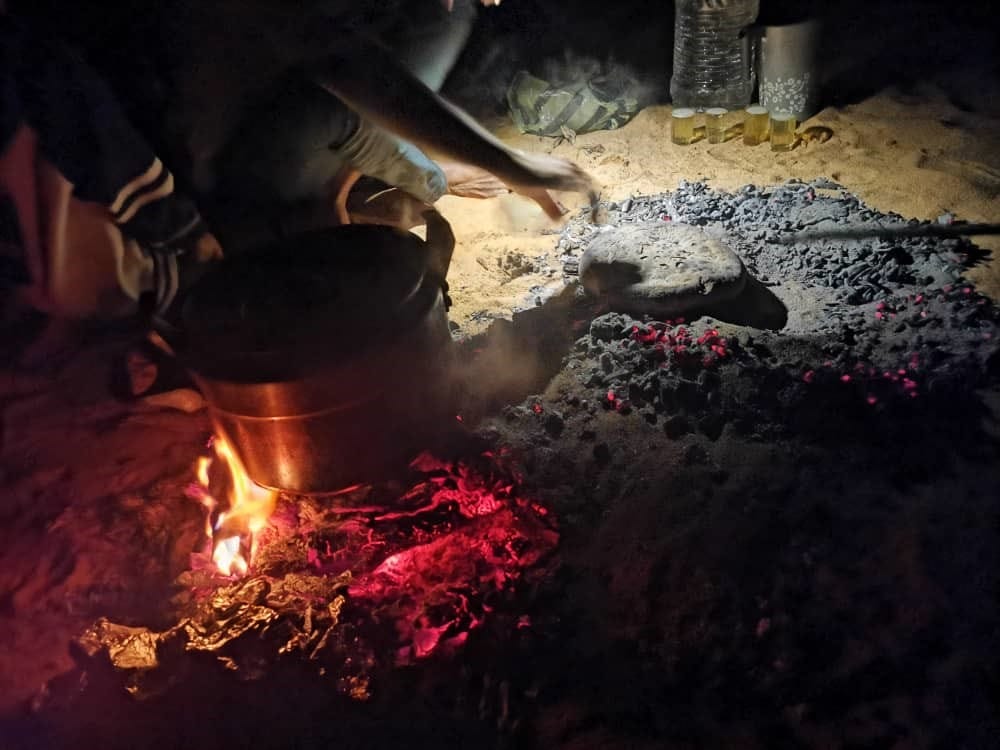
I was seeing my mother for the first time after a long separation. My uncle and his son were with us. We gathered wood and built a fire to boil the tea and to have the coals needed to heat the sand for taguella. We sat around the blazing fire, placing the teapot in front of us. Above our heads shone the stars and enveloping us was the deep, calming sound of the desert, as if the universe were created from silence. I was amazed by the crackles of fire breaking the silence and the brightness of the stars over that quiet, vast landscape.
Tea boiled over the flames, sending its vapor skyward. When the coals were ready, we took the dough that my cousin had made and buried it in the sand and hot ash. After about two hours, we dug it up, brushed it off, and broke it into pieces to eat with my mother's goat stew.
My mother, undemonstrative by nature, treated me with a great deal of warmth that night. I saw her usually serious features transform into those of a happy child: laughing a lot, telling stories, and recalling all the happy moments she had experienced. It was as if I were observing a different person. She expressed her love indirectly, placing carpets under me to protect me from the cold sand and giving me a large piece of meat. That night I witnessed the soul's ability to manifest in different forms, reflecting one's mood.
How to Bake Taguella
- The Dough: Make a simple dough from semolina wheat flour, water, and salt. No yeast needed. Knead the dough until it is smooth and elastic.
- The Fire: Build a fire in the sand and let the wood burn down to embers. Then push the glowing embers aside and set the dough directly onto the hot sand.
- The Baking: Cover the dough in more hot sand and ash, and let it bake for about 2 hours.
- The Eating: Unearth the bread, brush it off well, and break it into chunks to sop up a meat broth or stew with vegetables. (We use red meat. Tuareg people despise eating chicken, and some cannot stand fish, either. Unlike other North Africans and Africans, most Tuareg also dislike spicy food. The taste of food is measured by its fat content, not spices.)
Member discussion