Chesterton and Shaw: a Century-Old Tweet War
Some thoughts on keeping calm and keeping friends in frought times.

I gave up alcohol and sweets, but I’ve been scrolling through Twitter again. What do impassioned political tweets have to do with gooey chocolate-chip cookies? They both spike dopamine levels, creating an addictive loop of action and reward. Anything for a fix, man.
In fact, it turns out that the neurotransmitter dopamine is inseparable from learning and motivation. It gets us fired up not only to bake cookies but also to acquire new knowledge and skills. Without dopamine, we probably wouldn’t bother to get out of bed, especially when it’s 25 degrees with snow on the way.
Unfortunately, the power of that action-reward circuit means we can easily get addicted to anything that triggers a hit. When something spikes dopamine artificially high—like a giant iced sticky bun or the social cohesion of shared outrage—the feeling lasts only briefly; then levels drop even lower than normal, and we start looking for our next fix.
In other words, our monkey brains are suckers for the “react first, think later” world of social media. Deep in some limbic circuit (I’m no neuroscientist), the villagers are still waving torches and pitchforks, and we wanna join the party. But, really? Torches and pitchforks in the 21st century? Surely, we can do better.
The most pressing question on my mind is how we hold fast to our relationships in these storms of addictive moral outrage. The crises that trigger the rants and retweets may be real, but losing our loved ones won’t resolve them.
For inspiration I’m looking back to a famous friendship between ideological opposites: G.K. Chesterton and G.B. Shaw. I thought of them recently when I rewatched the classic My Fair Lady, based on Shaw’s 1913 play Pygmalion.
Chesterton the English Orthodox Christian (among other things) and Shaw the anti-religious Irish Stalin sympathizer (among other things) had almost nothing in common except their keen wit and literary fame.
Chesterton was chubby and often befuddled. He had a neurological condition that made him frequently forget where he was going. He once telegrammed his wife, "Am in Market Harborough. Where ought I to be?" She wired back, “Home.”
Shaw, on the other hand, looked exactly as I picture the philosopher Mr. Ramsay in Virginia Woolf’s To the Lighthouse:
lean as a knife, narrow as the blade of one, grinning sarcastically….with some secret conceit at his own accuracy of judgement. What he said was true. It was always true. He was incapable of untruth; never tampered with a fact; never altered a disagreeable word to suit the pleasure or convenience of any mortal being….
Chesterton and Shaw fostered a close friendship even while taking constant potshots at each other.
Chesterton: "To look at you, anyone would think a famine had struck England."
Shaw: "To look at you, anyone would think you had caused it."
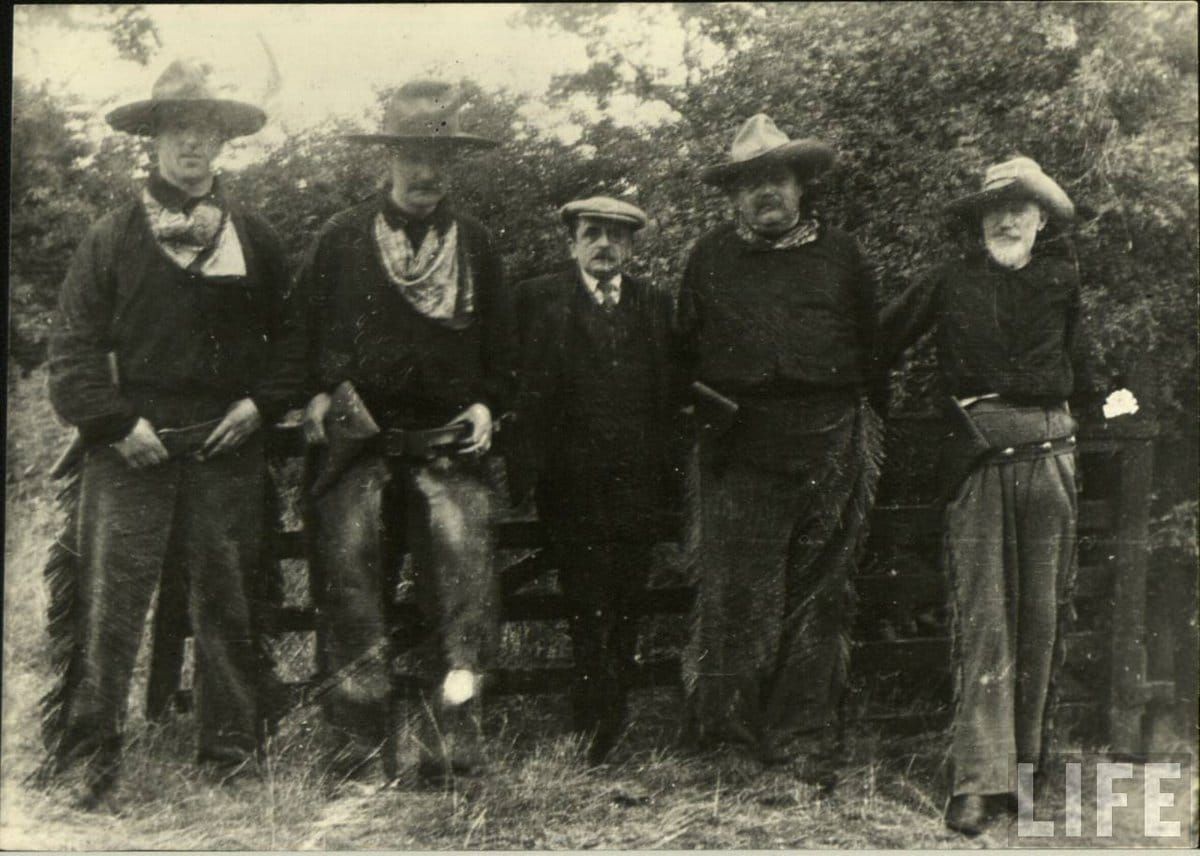
They even acted together in an ill-fated Western directed by J.M. Barrie, the author of Peter Pan. Chesterton described the filming thus:
We … were rolled in barrels, roped over fake precipices and eventually turned loose in a field to lasso wild ponies, which were so tame that they ran after us instead of our running after them, and nosed in our pockets for pieces of sugar. Whatever may be the strain on credulity, it is also a fact that we all got on the same motor-bicycle; the wheels of which were spun round under us to produce the illusion of hurtling like a thunderbolt down the mountain-pass. When the rest finally vanished over the cliffs, clinging to the rope, they left me behind as a necessary weight to secure it; and Granville-Barker kept on calling out to me to Register Self-Sacrifice and Register Resignation, which I did with such wild and sweeping gestures as occurred to me; not, I am proud to say, without general applause.
The friends’ connection wasn’t all fun and barrel rolls, though: Chesterton and Shaw had real, intractable disagreements about deeply important matters.
Chesterton wrote:
I have argued with [Shaw] on almost every subject in the world: and we have always been on opposite sides, without affectation or animosity…It is necessary to disagree with him as much as I do, in order to admire him as I do; and I am proud of him as a foe even more than as a friend.
Why is it so hard to imagine anyone saying that about anyone else in 21st-century America? One reason is that we struggle to agree on a set of facts from which to argue. Most of us are content to burrow down into echo chambers like my cat Marcel in his winter blanket cave. What’s the incentive to come out?
If we brave the cold, we get to have breakfast. And if we brave the cold, we get to breathe open air and confirm that the people we disagree with are fellow human beings and not, say, evil space lizards.