Classic Horror Picks
My top 10 list of scary things invisible and inescapable...

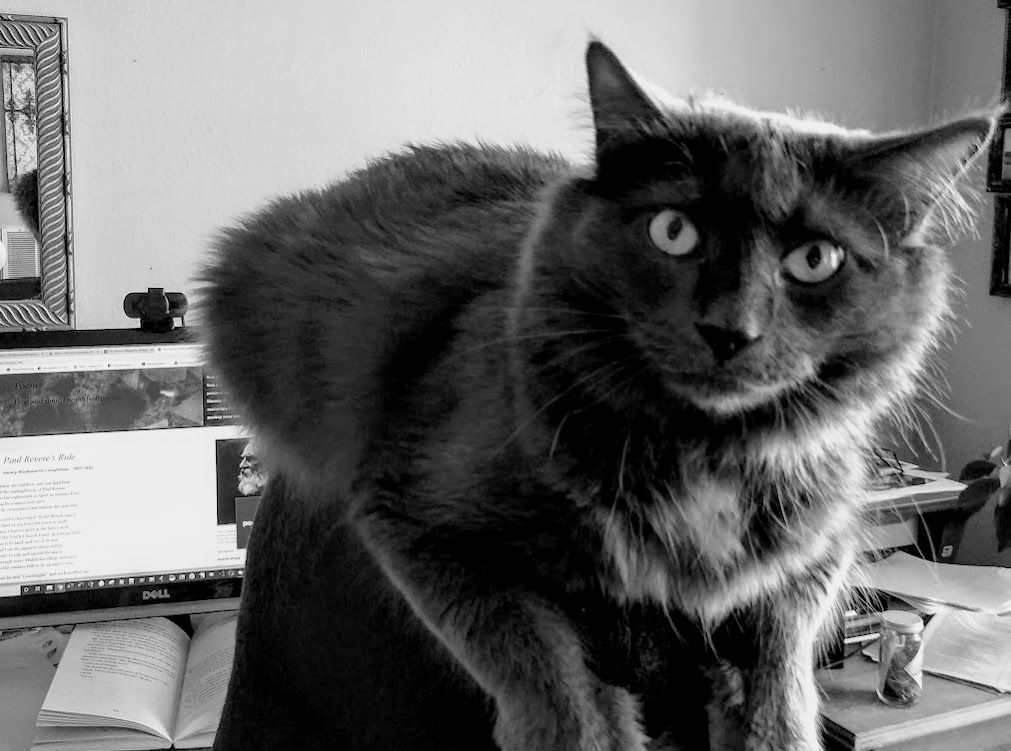
Halloween is a week away: wish me luck getting that bat costume onto my 20-lb. street cat. (“The things we do for your Instagram, Karen.”) Meanwhile, after focusing on the tragic Mideast, I thought I’d lighten up with my favorite fictional horror.
As a kid I would scare myself witless with horror classics that I snuck from my older brother’s bookshelf. I still prefer those restrained, atmospheric stories over show-and-tell gorefests. I also still have a soft spot for those plucky Victorians confronting the unspeakable from their leather armchairs. Dammit, I want to sit in front of the fireplace and sip port while perusing some secret, profane journal that ends with a shaky “It’s found me! I—.” Of course, as a woman, I’d more likely be locked in my room to claw at the wallpaper (see The Yellow Wallpaper below). But anyway…
The Gothic Golden Age: Can Science Save Us?
The 1800s and early 1900s were a golden age for horror and gothic fantasy. Click for an excellent short history of gothic horror by the New York Public Library.
Many of those classic tales reflect the era’s uneasy relationship with science: could armchair theories explain the power of evil? Could potions brewed in a lab somehow vanquish it? Is science the panacea for our worst fears, or are we just kidding ourselves? (Spoiler alert: we’re kidding ourselves. It’s found us—run!)
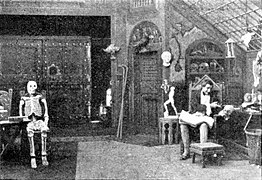
Love vs. Evil, or Monsters Have Feelings Too
Another recurring theme in my favorites is the spiritual battle between love and evil. That battle may take place within a character or between two characters who embody those poles. The human is not always the hero; sometimes, the most human character is the monster.
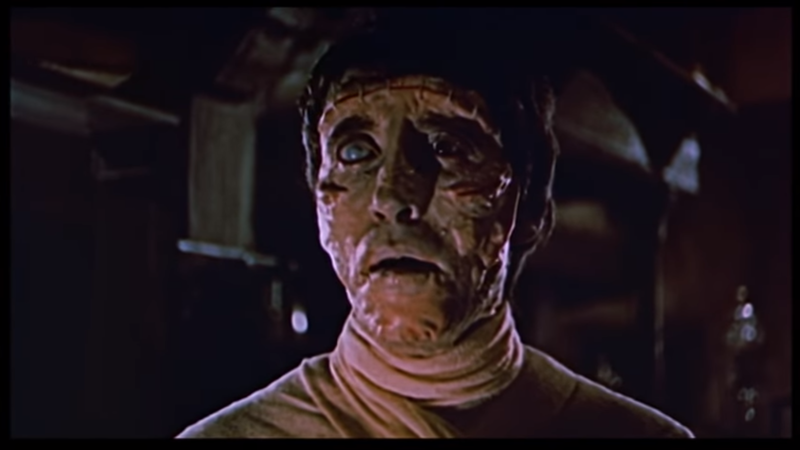
A Subjective List, or It’s My Halloween Party
There are some big omissions here. For example, I’m not including anything by H.P. Lovecraft even though his name is metonymic for horror. I haven’t skipped him because he was (holy crap!) a racist who fantasized about murdering Jews on the subway; I just haven’t read his stories since my 20s and don’t remember them very well. They never were my kinda thing.
I’m skipping Poe, too, regretfully. Edgar Allan Poe was a master of the macabre and a pioneer of the short-story genre, but I’ve written so many high-school lessons on his stories that…well. “The Tell-Tale Heart” is definitely worth a reread, though.
So here goes: Things Invisible’s top 10 (technically, 11) horror stories and films.
Carmilla and “Green Tea” by Sheridan Le Fanu
Sheridan Le Fanu (1814–1873) was an Irish writer of gothic, mystery, and horror fiction and an inspiration to many horror writers after him—including Bram Stoker, whose Dracula came 26 years after le Fanu’s Carmilla.
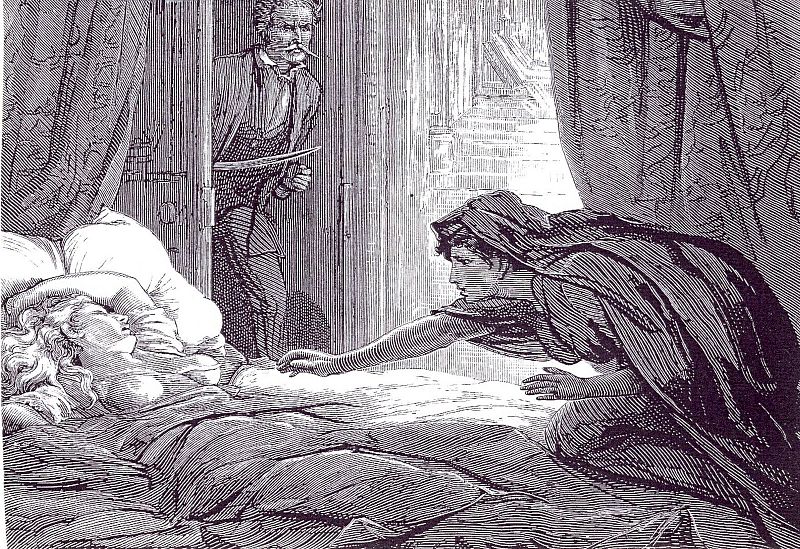
Carmilla
A young woman is preyed upon by a beautiful vampire named Carmilla who appears to be a girl her age. They become close friends, though Carmilla is oddly reserved about her past. Meanwhile, young women in neighboring towns start dying of an unknown malady…and there are those strange puncture marks in their necks…
The vampire is wicked not because she likes girls but because she destroys what she loves. Carmilla wasn’t just an inspiration for racy lesbian vampire flicks; it was the first story to make the vampire a tragic figure.
Here is the novella on Project Gutenberg.
“Green Tea”
A habit of sipping green tea opens a young man’s “inner eye” to a demonic monkey. The story is creepy whether you read it as a psychological study (the man is overly caffeinated/mentally ill) or as supernatural horror.
It used to spring on a table, on the back of a chair, on the chimney-piece, and slowly to swing itself from side to side, looking at me all the time. There is in its motion an indefinable power to dissipate thought, and to contract one's attention to that monotony, till the ideas shrink, as it were, to a point, and at last to nothing—and unless I had started up, and shook off the catalepsy I have felt as if my mind were on the point of losing itself.
“Green Tea” was published in 1872, just a year before Le Fanu’s death. By then, the expression having a monkey on one’s back was in use with the meaning “to be angry” or “to have a terrible burden.” I wonder if “Green Tea” is the reason that idiom came to stand for addiction. That nasty little monkey ruins everything good in the green-tea drinker’s life. It won’t let him be for a minute. As a former smoker and recovering sugar junkie, I can relate.
Dracula by Bram Stoker
Though I’ve seen just about every Dracula movie out there, I’d never read the novel until I came across this cool Dracula Daily substack. Since the novel consists of dated journal entries and letters, you can subscribe to get an email with that day’s entries in the novel. I’m surprised at how freshly scary the story is.
Movie-wise, I like Francis Ford Coppola's 1992 version with Gary Oldman, Winona Ryder, and Anthony Hopkins. It forces us to have sympathy for the devil—after all, he just wants his love back—even while he scares the bejesus out of us.
Frankenstein by Mary Shelley
With Frankenstein, Mary Shelley shifted the Enlightenment focus from “science against evil” to the dangers of science itself, especially when used in service of human arrogance. We have the figurative expression “created a monster” because of Frankenstein—although Dr. Frankenstein’s exact words were:
…created a fiend whose unparalleled barbarity had desolated my heart and filled it for ever with the bitterest remorse.
Those mad scientists are never sorry till it’s too late.
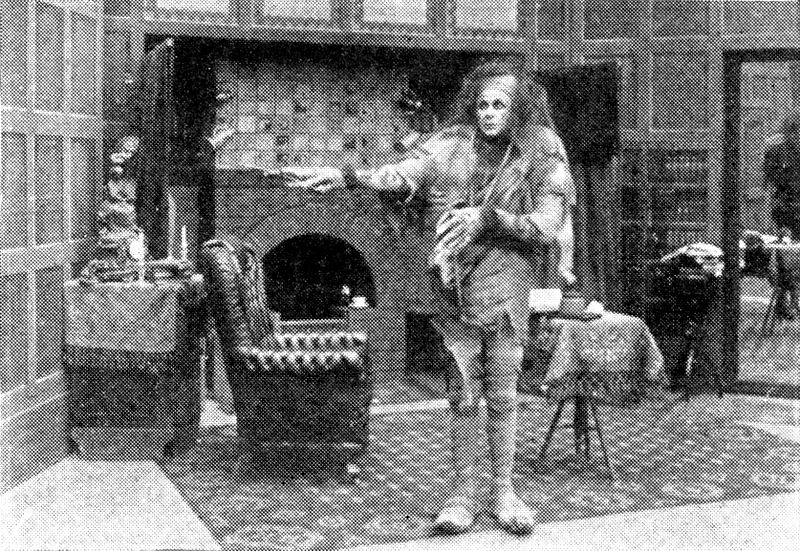
The story of the novel’s birth is fascinating, too. Shelley wrote Frankenstein when she was only 19, in the aftermath of the deadliest volcanic eruption in history. The 1815 eruption of Mount Tambora in Indonesia was apocalyptic: it killed about 100,000 people at the time and then ended up killing millions more by leading to mass starvation and a cholera pandemic. That “year without summer,” several writers and composers penned dark masterpieces.
Mary had run off with the married Percy Bysshe Shelley when she was just 17. In 1816 the disgraced couple were traveling in Switzerland with their four-month-old baby. (Later that year, they would marry after his poor wife committed suicide.)
Bad weather kept them cooped up indoors with the dissolute Lord Byron and Mary’s stepsister Claire, who was pregnant with Byron’s child and obsessively trying to win him back. In the midst of all this weirdness, Mary quietly listened to Percy and Byron discuss the limits of modern medicine, including whether a corpse could be “galvanized” back to life. Then she went off and wrote a masterpiece of horror.
In Shelley’s tale, the creature is a tragic victim:
I do know that for the sympathy of one living being, I would make peace with all. I have love in me the likes of which you can scarcely imagine and rage the likes of which you would not believe. If I cannot satisfy the one, I will indulge the other.
Who can blame him?
A Girl Walks Home Alone at Night
I can’t resist adding this modern-day “Iranian vampire western.” One of the highlights of this eerie, dreamlike movie is the cat, who kept hanging around the set until it became central to the story. Cats have a way of taking over like that.
Someone pointed out that the self-described “bad” vampire is the most moral creature in the film. True. Or: she’s a kind of moral arbiter. But mainly, this is a story of love between sinners. Do they deserve love? Can they let themselves have it? A chador makes the perfect vampire cape, especially on a skateboard. Just saying.
The Great God Pan by Arthur Machen
Arthur Machen was a Welsh horror and fantasy writer whose stories still can make me turn on a nightlight.
"We are standing on the brink of a strange world, Raymond, if what you say is true. I suppose the knife is absolutely necessary?"
"Yes; a slight lesion in the grey matter, that is all; a trifling rearrangement of certain cells….”
In this novella, a doctor operates on the brain of his orphaned ward to remove the veil that protects human eyes from the wondrous sights of the “true” world. It’s sort of like escaping Plato’s Cave with a scalpel (jabbed into somebody else’s head) and then finding you’ve opened a portal to hell. Yes, Dr. Raymond is sorry now, but it’s too late.
On its publication in 1894, reviewers denounced Machen’s novella as degenerate for its hints of sexual depravity. Ironically, nothing could be more Victorian than Machen’s casting of sensual abandon as a hallmark of evil.
The Haunting of Hill House by Shirley Jackson
God God—whose hand was I holding?
Though published in 1959, this novel has to be on any list of classic horror. Stephen King called it one of the finest horror novels of the late 20th century. Jackson was a master of creating terror by hinting at what’s happening and letting our imaginations fill in the rest.
In the great gothic tradition, this story is also about the folly of trying to scientifically study evil. (Run, you idiots!)
For a movie version, I recommend the 1963 The Haunting, which sticks close to the plot and atmosphere of the novel. Thumbs down to the silly 1999 gorefest of the same name with Catherine Zeta-Jones.
“The Monkey's Paw” by W. W. Jacobs
A macabre “three wishes” story written in 1902. Again, the horror is in what is not seen. Like the demonic monkey in “Green Tea,” the monkey’s paw in this story takes good things like human caring and turns them into…bad things.
He took the paw, and dangling it between his forefinger and thumb, suddenly threw it upon the fire. White, with a slight cry, stooped down and snatched it off.
“Better let it burn,” said the soldier, solemnly.
Here’s a special illustrated edition by Slate.
Only Lovers Left Alive
Another beautiful, atmospheric vampire flick—though it’s really more of a love story in which the centuries-old couple are incidentally vampires. I love the soundtrack and the characters’ languid, world-weary observations on human art and folly.
The Turn of the Screw by Henry James
Is The Turn of the Screw a genuine ghost story or an account of an overwhelmed young governess’s descent into madness? Nobody knows. Whichever it is, the story scares the wits out of just about everyone who reads it. Although he wrote it as a “potboiler” for some much-needed income, James ended up scaring even himself:
I had to correct the proofs of my ghost story last night, and when I had finished them I was so frightened that I was afraid to go upstairs to bed!
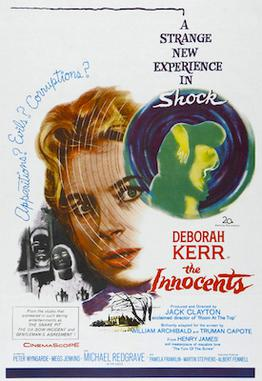
Check out the faithful 1961 film version, The Innocents.
The Yellow Wallpaper by Charlotte Perkins Gilman
If a physician of high standing, and one’s own husband, assures friends and relatives that there is really nothing the matter with one but temporary nervous depression—a slight hysterical tendency—what is one to do?
Indeed, if one is a gentlewoman in 1892 with a controlling husband, what is one to do? This short story is an early work of feminist literature as well as effective horror. Written as a series of increasingly unhinged journal entries, it shows the consequences of the hideous practice of treating “nervous” women by shutting them up in their rooms and not allowing them any mental stimulation or creative outlet. Yes, the quack doctor and control-freak husband are going to be sorry.