Key Ingredients
Some thoughts on modernist murder, mud-brick ovens, and a sustainable life.

Hi, everyone. I hope you’ve had some comfort and respite from whatever life has thrown at you this week. For me the last two weeks have held lots of duck paddling below the surface with little to show for it, writing-wise. On the other hand, there are coffee and cats.
Actually, I have even less to show now than I did before: I unpublished my article on Ezra Pound because I'm rewriting it as an essay to submit to a magazine. Links and images are luxurious shorthand; without them, the words have to carry all the weight. Also, I realized I needed to better set Pound’s context as a genocide-cheering intellectual. In the 30s and 40s, he had company at both ends of the political spectrum.
W.H. Auden didn’t cheer killing, exactly, but he got a blast from George Orwell for the phrase “necessary murder” in a poem about the Spanish Civil War. Orwell, who fought in the trenches of that war, retorted in his three-part essay "Inside the Whale":
[That phrase] could only be written by a person to whom murder is at most a word. Personally I would not speak so lightly of murder. It so happens that I have seen the bodies of numbers of murdered men – I don't mean killed in battle, I mean murdered. Therefore I have some conception of what murder means – the terror, the hatred, the howling relatives, the post-mortems, the blood, the smells. To me murder is something to be avoided.
Question on a spring morning in Virginia: Is abstraction—the detachment of mental constructs from experienced reality—a key ingredient of mass murder? As societies, how do we prevent anti-human ideas from hijacking our minds and hearts? Asking for a friend and a country.
The day after Earth Day, I’m also wondering why mass sanity never seems to take. Partly it’s because our fear of slowly building problems like climate change isn’t acute enough. Our brains are wired to respond to visceral threats (real or fabricated) in the moment, not to safeguard the future with difficult sacrifices today. The catch, of course, is that “when my backyard is on fire” is probably too late.
I’m only human, too, and it feels unreal to be thinking about past and impending catastrophes on such a beautiful day. Shouldn’t I be taking a walk?
In 1943, Dutch diarist and Holocaust victim Etty Hillesum wrote in a letter from Westerbork labor camp as she watched a train crammed full of people depart for Auschwitz:
The sky is full of birds, the purple lupins stand up so regally and peacefully, two little old women have sat down on the box for a chat, the sun is shining on my face — and right before our eyes, mass murder. The whole thing is simply beyond comprehension.
The whole thing is simply beyond comprehension.
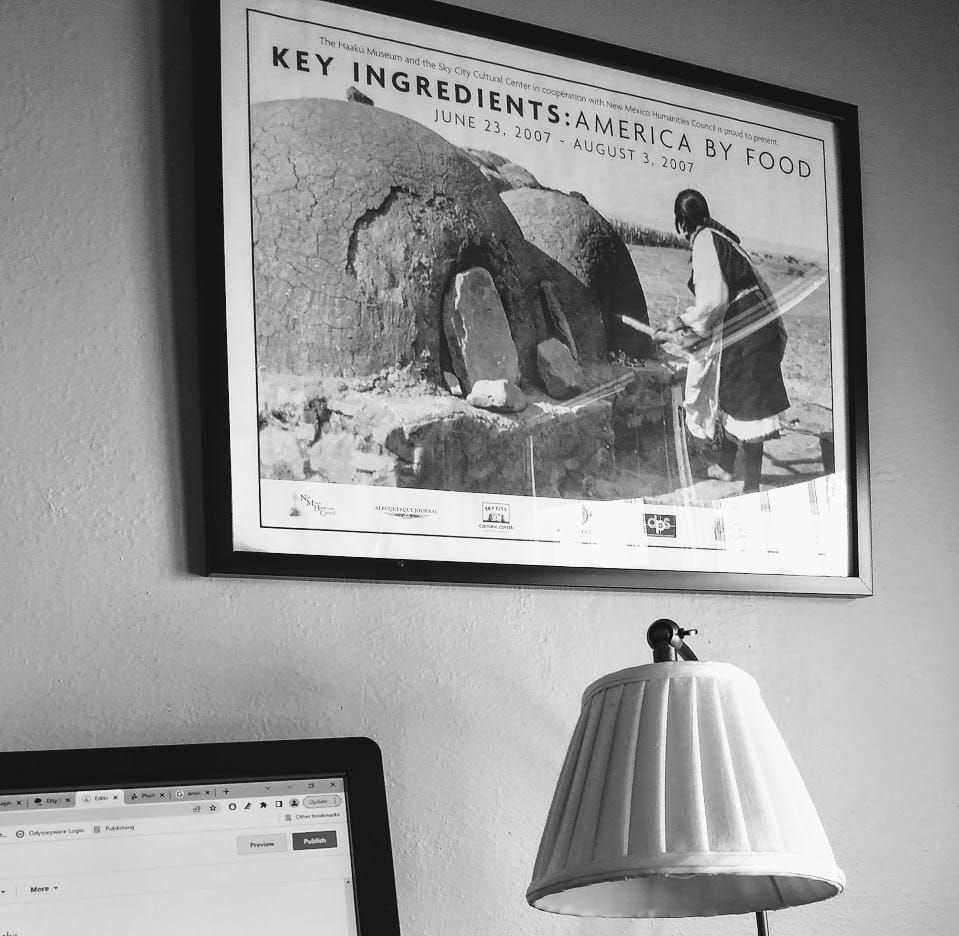
Above my desk is a poster from Acoma Pueblo near Albuquerque, New Mexico. The village is one of the oldest continuously inhabited communities in the U.S: the Acoma people have lived there for more than 2,000 years. In Sky City, or Old Acoma, people still bake their bread in mud-adobe ovens.
I visited Acoma in 2007. An exhibit at the museum had just ended, and they had thrown the poster away. The staff kindly let me fish it out of the trash. The date on the poster forever places in time for me that trip with my mother and stepfather. Along with Acoma, we visited the patch of land they had bought about an hour away near El Morro National Monument. At the time of our trip, they had started building a geodesic dome house out there.
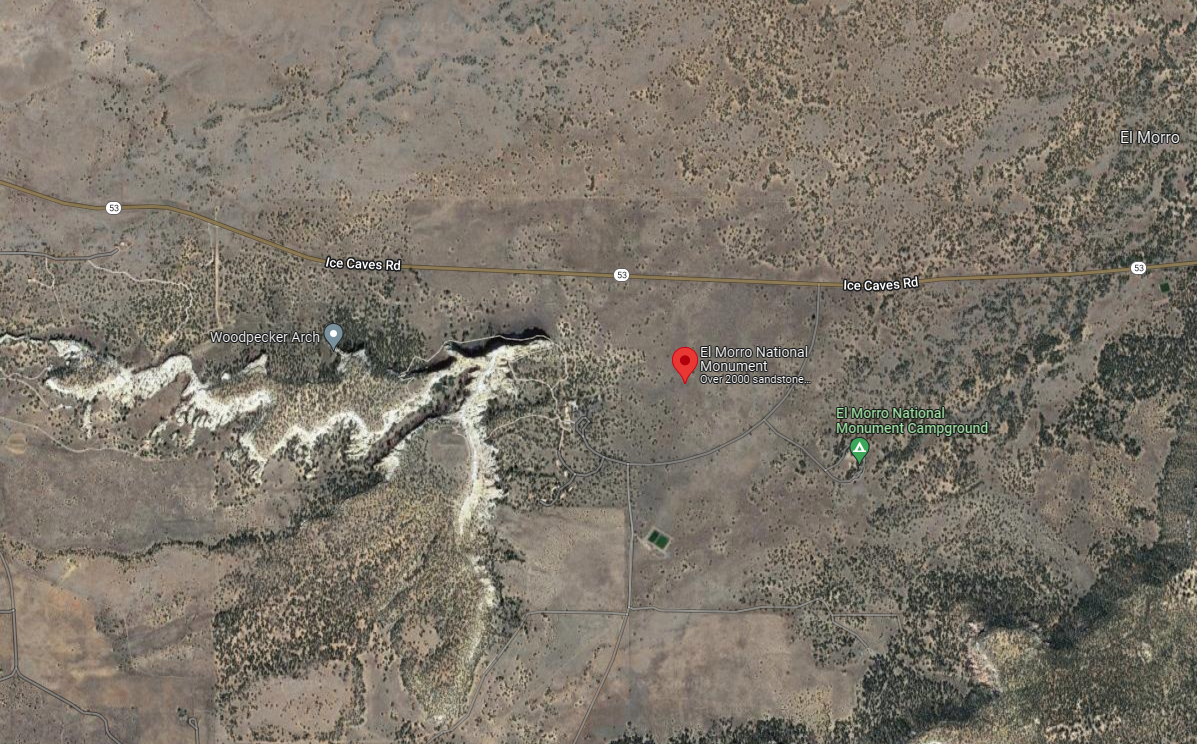
I’d never in my life felt such deep silence as I did on that remote, scrubby desert land. Just as the dirt was marked only by plate-sized elk footprints, the stillness was broken only by my mom’s chatty exclamations: “It sure is quiet out here! Can you believe how quiet it is?”
I don’t know what my company-loving mom was thinking: she couldn’t have lived out there for even a week. But she was prepping for the world going all to hell, and a last-ditch refuge was part of the plan.
On their property was an ancient dugout of sorts. We found shards of pottery—one with a small thumbprint still in it—and charred kernels of corn. Climbing down into that dugout, I could begin to imagine being one of a small band of humans in a hostile, parched wilderness that I called home.
It was a holy, heart-stirring place, and I wouldn’t have lasted a week out there, either. Driving back to civilization, I sighed with relief at the sight of a Walmart sign.
Questions for the duration: What are the key ingredients of a sustainable modern life? Can we find some middle ground between mud-brick ovens and microwaves, between Acoma and the slick cities that spew our demise? Can we somehow ensure that our ideas for how to live are grounded in reality?
A key principle of the Iroquois people was, "In every deliberation, we must consider the impact on the seventh generation."
Can we at least aim for the second or third?
Now I’m off for a walk.