Let's Tell the Future
Winter Solstice and a Wicked Pack of Cards: Discovering Pamela Colman Smith

Madame Sosostris, famous clairvoyante,
Had a bad cold, nevertheless
Is known to be the wisest woman in Europe,
With a wicked pack of cards….
—T.S. Eliot, The Waste Land
The modernists have been haunting me in the strangest of ways. Last week I discovered the illustrator of T.S. Eliot’s “wicked pack of cards.”
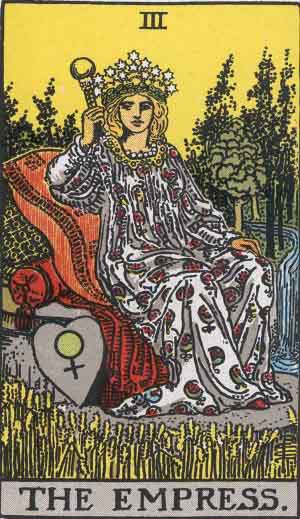
I already knew the Rider-Waite tarot deck well; I first saw it on my brother’s shelf when I was a kid, and I have a deck on my own bookshelf. But I had to “discover” the artist who painted those iconic images. By the time the cards became famous, she had been eclipsed so fully, you’d think that a publisher in cahoots with a buttoned-up English scholar of the occult had created the deck all by themselves. No sharp-witted, synesthetic Brooklyn suffragist with feathers in her hair to see here! Move along to the divination, please.
Backing up: what happened was that I finally finished unpacking the boxes my friend Sandy had mailed to me in the last month of her life. It was a poignant unwrapping. First, tucked between books were two black-and-white postcards depicting a child’s sense of wonder. In one, the child looks wistfully from her bed toward light streaming in through her window. In the other, a work by George Oddner called “The Child in the Temple,” light enters from behind the child as he gazes between pillars of the sanctum.
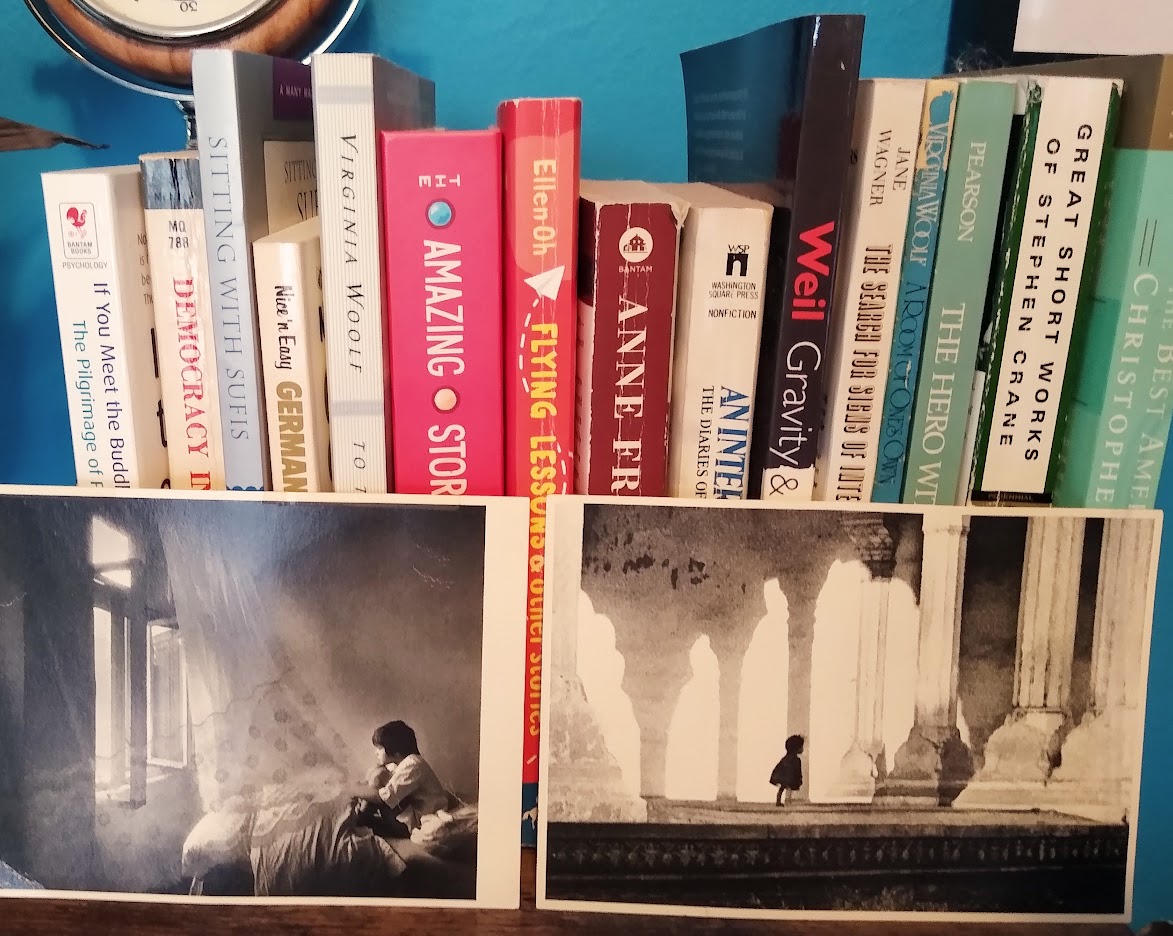
Then a small box inside a box yielded several decks of tarot cards, both traditional and not. When I took the cards from their thin sleeves and held them to my nose, they smelled of incense—and Sandy's old apartment from 20 years before. The cards probably had sat unopened for decades, now releasing their trapped scent like a genie from a bottle.
I think Sandy, like me, saw the tarot as imagery for contemplation instead of divination. Who wants to know the future, anyway? Not me. Either we’ll wade gamely through the backwash of our own mistakes, tugged forward by a tensile thread of grace, or we won’t. The older I get, the more I feel as if we're just holding space here for the next generations.
But divination through cards has a long history. Cartomancy with regular playing cards gained popularity in Europe in the mid-18th century, and the use of the ancient tarot deck for this purpose soon followed. The 1909 Smith-Waite deck (there, I fixed it!) marks the rising popularity of tarot for divination in the English-speaking world.
While contemporary decks often soften the imagery, the 1909 deck pulls no punches.
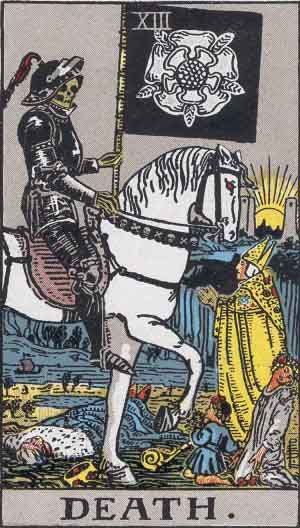
Yes, a skeleton in medieval black armor prancing over corpses is creepy as hell. But symbolically, Death can be freedom and rebirth, too. The corpses on the ground, terrible as they are, nourish (what kind of place is this, anyway?) spring growth.
Death can be a bitterly cold solstice like the one in which I write this, huddling by a space heater because the power company just begged us all to spare the grid to save our future selves from freezing in the dark. Winter pares things down to the bone, sends them into hibernation, holds the green fuse in trust for spring. (And as Eliot asserted in the first lines of The Waste Land, spring can be even crueler.)
So now I think there are worse cards than Death to draw from the deck. I mean, check out the Nine of Swords. It’s as if the wonder-filled child in Sandy’s postcard had grown up into a world that abandoned her, locking her up in the dark and wielding its sharp edges. Or maybe this image shows what happened in the early 19th century to women who tried to live a life centered on their own dreams.
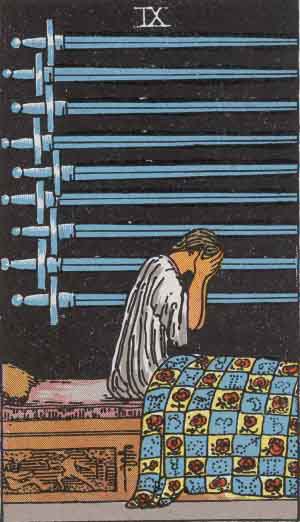
1909 was also the year Eliot published The Waste Land after mad Ezra Pound had whittled the manuscript down to its laconic bones. According to various sources, the “wicked pack of cards” in Madame Sosostris’s hands was the Rider-Waite tarot.
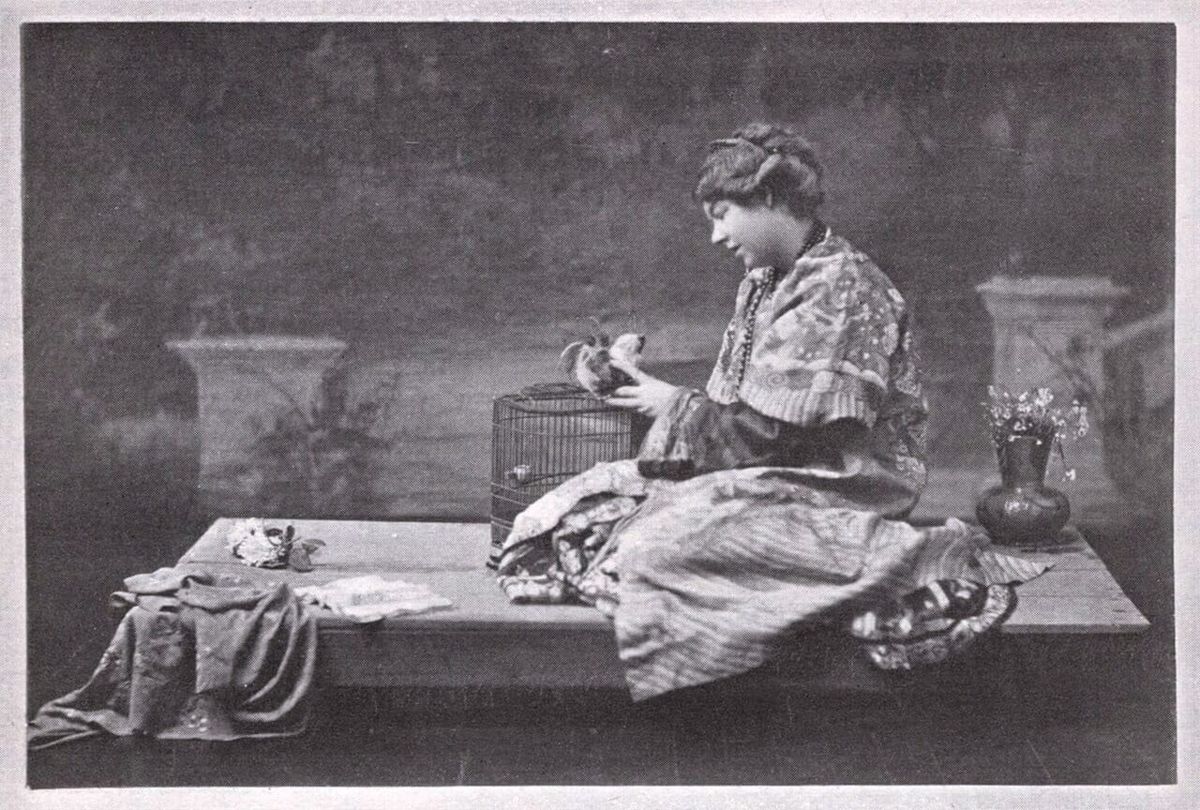
Without further ado, here’s the artist of those images, Pamela Colman Smith.
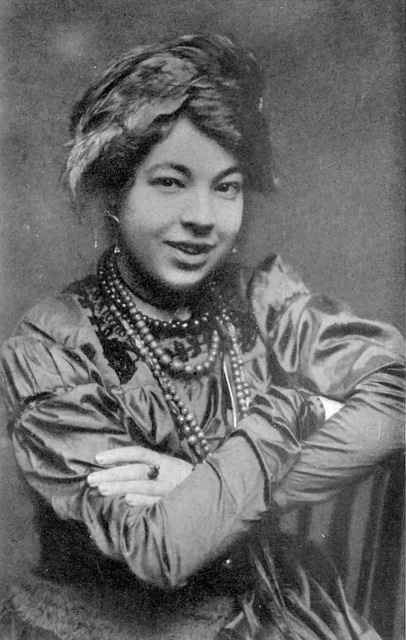
She’s a Brooklyn genie who smirks, You want a wish? Careful what ya ask for, Bub. Her nickname was Pixie, and yes, those are feathers in her hair.
She was the daughter of a Jamaican black mother and an American white father. Though born in London, she traveled with her father and grew up partly in Jamaica and partly in New York. She returned to her father’s hometown of Brooklyn at 15 to study drawing, painting, and print making. After her mother’s death in 1896, Smith dropped out of school to join a traveling theater group and perfected the arts of costume making and set design. By the age of 21, she was an orphan—and an unmarried young woman living a remarkably independent life.
Back in London, her talent as a book illustrator put her in high demand. She illustrated works by Bram Stoker and William Butler Yeats, among others. Along with her commissioned illustrations, Smith painted synesthetic visions that came to her while listening to music. These works so impressed the photographer Alfred Stieglitz that he exhibited them in his New York gallery.
Yet Smith was not only an artist; she was the center of a community. Her Chelsea studio became a weekly gathering spot for other artists and writers, some of them famous or about to be.
English writer Arthur Ransome described a visit to one of Smith’s salons:
“She welcomed us with the oddest shriek,” Ransome recalls of meeting Pixie for the first time, in 1901. “It was the oddest, most uncanny little shriek, half laugh, half exclamation. It made me very shy. It was obviously an affection, and yet seemed just the right manner of welcome from the strange little creature, ‘god daughter of a witch and sister to a fairy’ who uttered it.”
In a ‘mad room out of a fairy tale,’ with its walls covered in drawings and paintings from around the world, and curated with such fanciful artifacts and baubles as to ‘have the effect of a well designed curiosity shop,’ Ransome was treated to an evening of poetry, storytelling, and song. Pixie and her friends performed for one another amid the smoke of cigarettes and thick incense….
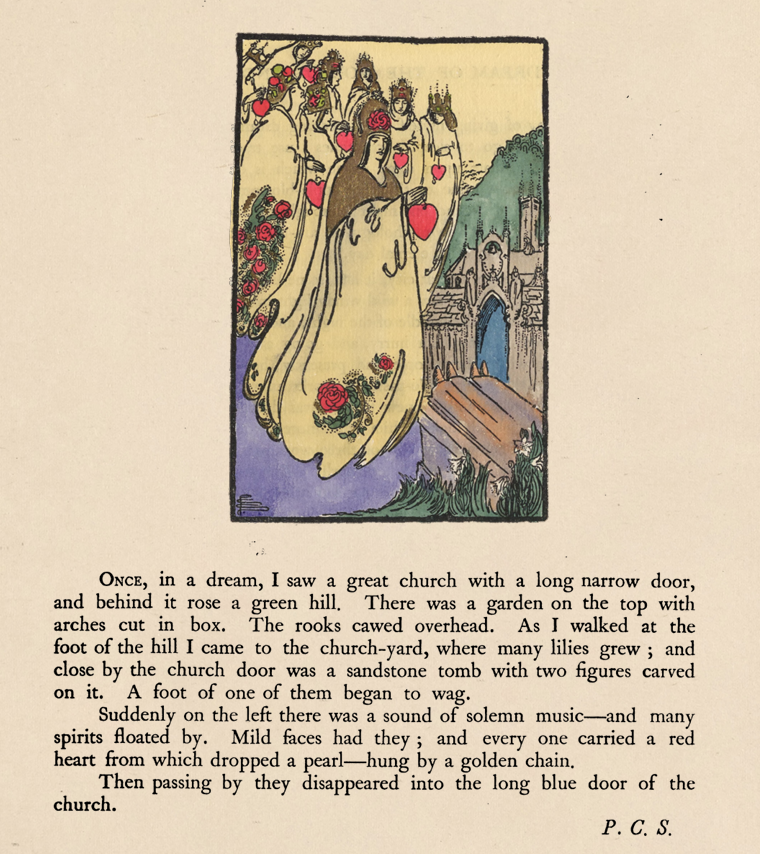
That passage is from the introduction to a remarkable collection that Smith illustrated and edited in 1903, The Green Sheaf. Yeats is in there, and Dante Gabriel Rossetti, and William Blake.
This selection, “Once in a Dream,” was entirely her own:
Along with being a working artist, hosting bohemian salons, and publishing books, she also found time to be an active suffragist. She was a member of the Suffrage Atelier, a group of artists who contributed their work for the cause.
As a whole, Smith’s life and body of work make it clear that her tarot illustrations were much more than rote implementations of Waite’s ideas. The images came from her creative imagination and her intuitive engagement with the symbols. For example, Waite apparently gave little guidance for the Minor Arcana, or lower cards—the Wands, Cups, Swords, and Pentacles. Smith’s gouache watercolors were the first to integrate people into those images, elevating them with richly symbolic imagery.
And yet for almost a century, as far as I can tell, her name appeared nowhere on the box. Was it ordinary sexism, or was it a slighting of the artistic and intuitive, too? Waite was a dry cataloguer of the spiritual and occult; in contrast, Smith plugged into the living stream and peered, childlike, into the heart of the temple.
Like the artist Lily Briscoe at the end of Virginia Woolf's To the Lighthouse, Pamela Colman Smith had her vision. She died at age 71 after living a life that was uniquely her own creation. I'd like to tell her future:
Pamela, you will bring your visions and dreams to fruition. You will have many friends. You will be forgotten but then remembered and celebrated. 72 years after your death, a woman will open a box. In the box will be another box. As she opens it, she will breathe a faint scent of soap and incense and grieve the loss of an old friend. She will open a browser tab, and then another tab, and see you smiling like an uncorked genie. You are part of a community stretching down through generations—you are endless—so Pamela, go ahead and have the last laugh.