The News from Hobbiton
Or, why we don't need advice from a guy wearing the Ring of Power.

We live in a perpetually burning building, and what we must save from it, all the time, is love.—Tennessee Williams
All are needed by each one; / Nothing is fair or good alone.
—Ralph Waldo Emerson, “Each and All”
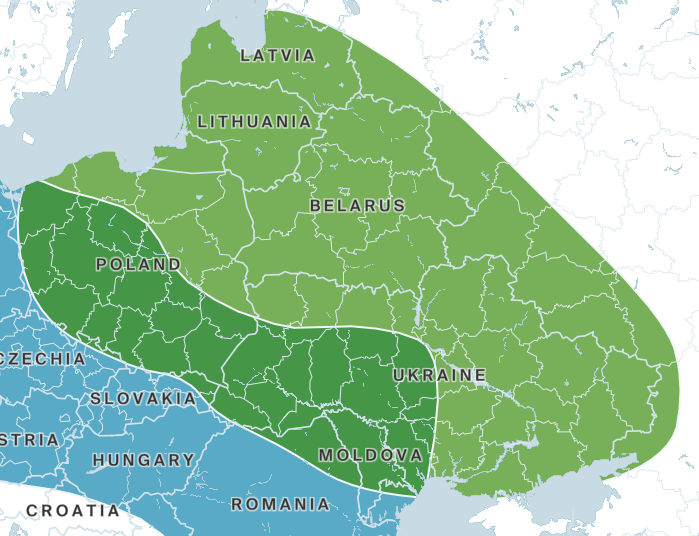
I live in the closest thing to a Middle Earth shire, and my ancestors hailed from even humbler outposts. My DNA says they all came from one small, amoeba-shaped splotch on a map; history books and family stories say the borders shifted violently around them. After a dark blob from the east swallowed up their shtetl, they had to find a way back into the light. Young, brave, and hopeful, my great-grandfather set out to sail by steerage to New York. There he somehow found food and shelter and then worked for years to prepare a soft landing for his wife and daughter. 150 years later, I—one of the many fruits of their love and toil—sit here in a peaceful valley, typing in fuzzy socks bought on sale at Walgreens.
My feet are warm, my bed is soft, and I have more than enough to eat. Outside my window, the only riot is a burst of fall colors. But just as it did for my great-grandparents and still does for their besieged homelands, the larger world looms like the shadow of the belly of a dragon. There are wars and rumors of wars. People in cities and towns everywhere hear cries of “existential threats” from several conflicting directions. And the richest man on earth, who gave a Nazi salute at the U.S. presidential inauguration, wants most urgently to tell us whom to fear and whom to trust, often against the evidence of our eyes, ears, minds, and hearts.
These thoughts started at walking distance from home: last week I set aside the English lesson I was editing to attend the annual awards luncheon of a charitable women’s organization. I work on their website from time to time, and a member kindly invited me as her guest. The members, mostly retired women, each chip in a couple of thousand dollars a year and then vote on which local nonprofit projects to fund with their pooled resources. This year they awarded grants to food banks, a group that donates beds for children, an Easter Seals summer camp, a mental health crisis center, and more. A representative of each recipient organization got up to explain what the funds would help them do, and by the end of lunch—munching a little raspberry-filled cookie and looking out over a sea of beautifully coiffed white hair—I was in tears. These women don’t have to help strangers eat, sleep, and have a bit of joy. They don’t have to do a thing except enjoy their retirement and grandkids, yet their faces shone: this work enriches their lives, and clearly there was no place they’d rather be.
It occurred to me that the richest man on earth could experience that kind of joy times billions every day of his life, and yet in every way and context, he does the opposite. His crowning achievement as a presidential advisor, along with stealing our private data, was to dismantle programs that fed starving children. Now he’s using the social media platform that he owns to tell us that 1) we are naive, helpless hobbits; 2) refugees are all murderous orcs; and 3) only “hard men” can save us from the poison of our empathy.
Here's what he tweeted last month about the complex immigration challenges in England.
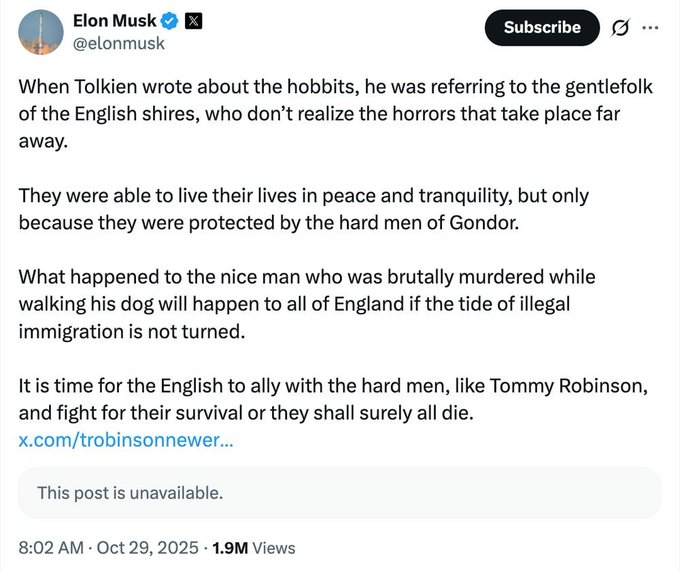
I had to look up Tommy Robinson: he’s a criminal fascist who once entered the U.S. illegally with someone else’s passport. I didn’t have to look up the plot of The Lord of the Rings. Having read the books as a kid and watched the film adaptations more recently, I can say with confidence that the writer of this tweet is Not Smarter Than a 5th Grader. I’ve grown numb to the unhinged scaremongering, but it shocks me that anyone would so blatantly misrepresent classic literature to serve their agenda.
For my own sanity, here’s a recap of what happens in the last book of the trilogy.
With extraordinary courage and heart, hobbits Frodo and Sam save not only the Shire but all of Middle Earth. Their “reverse quest” is to break the grip of the Dark Lord Sauron by destroying the Ring of Power, an object of such insidious evil that only a humble hobbit can carry it without becoming its slave. Even so, toward the end, there’s little left of poor Frodo: the ring’s evil has seized hold of him so strongly that he can no longer see anything else—can no longer even remember the simple pleasures of the Shire.
So Sam carries his friend the rest of the way. (I rewatched the film version last night and bawled over that scene.)
While the barefoot, parched hobbits struggle up Mount Doom, an epic battle rages for Gondor. It seems impossible for the armies of Gondor and its allies to save the kingdom from Sauron’s nightmarish horde of fiends, and even the great wizard Gandalf talks of defeat and death. But then the noble shieldmaiden Éowyn and the little hobbit Merry—laughingly dismissed by the men of Gondor as useless in battle—manage to kill the Witch-King, of whom a prophecy said that he would not be killed by a man. That and other unexpected developments turn the tide.
After successfully defending Gondor, future king Aragorn’s troops could be expected to rest, but they don’t. Instead, they challenge the demonic orcs at their stronghold to distract the Eye of Sauron, thus giving Frodo and Sam a chance to complete their task. It’s a desperate gambit, and they know they’ll probably all die, but they try anyway. (Aragorn’s speech at the Black Gate in the film still gives me chills.)
Each and all, it’s enough. Hobbits save the world with the help of men, women, elves, dwarves, walking trees, and some really creepy green ghost soldiers. The Fellowship of the Ring was always an uneasy alliance of beings with nearly irreconcilable differences, rallying together to defend life itself. Against all odds, it succeeds.
Any fifth grader can grasp the story’s themes better, apparently, than the world’s richest man. Power corrupts. Love, friendship, and wisdom combine with courage to save the day.
Likewise, students of history can better describe how and why empires actually fall. From what I understand, diversity worked out pretty well for ancient Rome, but starving people wasn’t such a great idea.
It’s worth noting that film versions of The Return of the King exclude the anticlimactic but important penultimate chapter, “The Scouring of the Shire.” When Frodo, Sam, Merry, and Pippin return home, they discover the struggle isn’t over yet. Their beloved Shire has been taken over by ruffians—hard men, if you will—who are plundering and polluting it at the command of an evil, disgraced wizard. The returning heroes aren’t having any of that: they rally their friends and neighbors, and those gentle, comfort-loving hobbits roust the thugs so that they once again can enjoy second breakfast in peace.
If our hometowns are Hobbiton, then what is the Ring of Power, and who will save us from its minions and their dark vision? Whatever form the darkness takes: us. We will save us—not by fighting, here in America, but by standing together and asserting what is real, true, and worth saving. Then, I hope, we or the next generation will get back to peaceful, silly, ordinary lives.
The lovely, elegantly dressed woman next to me at the charity luncheon surprised me by saying that she and other retired folks have been standing on a downtown street corner once a week, holding up signs and singing songs. “I do it for my grandkids,” she said.
This sounds like me after doomscrolling too long on social media. ↩