Pilgrim's Progress
A revisited offering on the Thanksgiving story.

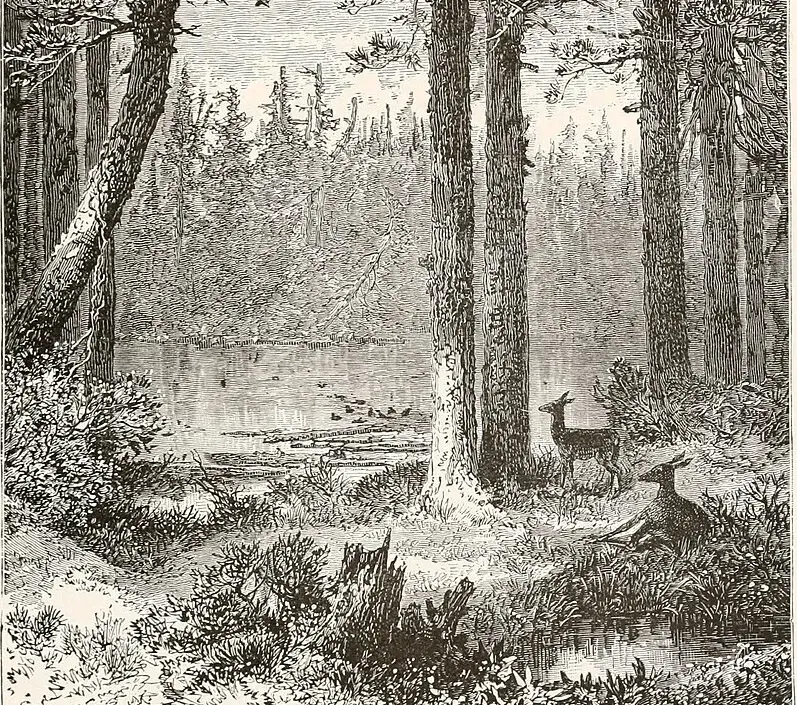
It’s Thanksgiving morning, a 16-lb. kosher turkey is roasting in the oven (many thanks to Stacy Lyn Harris for the recipe), and I’ve got a broom handy to wave at the smoke detector. I just realized that today is the first time this year that I’ve cooked meat at home. I haven’t gone veg again; I’ve just been too chicken to face my poultry. Some days I feel so raw at the bone that I’m ready to wave a protest sign at the whole eat-or-be-eaten shebang down here on Earth: Enough with all the suffering! Enough with the life and then not-life. What is going on here?
As Annie Dillard notes after posing that same question in “The Deer at Providencia”:
And as a rabbi friend said yesterday after sharing that he’d recently lost both his parents, “We carry on because we have no choice.” Then he asked a computer question and we sorted it out. Yay! Here’s to easy questions with simple answers.
Anyway, down here on Earth in Southwest Virginia, USA, prepping for a Christian-Jewish-Muslim Friendsgiving feast, I just feel grateful. Thank you.
Each year, I reshare some version of the Thanksgiving story and the history behind it. I’m not descended from that small group of pilgrims who once feasted with their neighbors before reverting to unneighborly behavior; I’m the grandchild and great-grandchild of immigrants who fled poverty and pogroms hundreds of years later. Still, somehow, a small group of persnickety folks in funny hats paved the way—all the way to my beloved, troubled America. It’s complicated. Like all of us, they couldn’t have made it without help.
Each year, I feel moved to honor the hero of the story. None of us would be here without a man named Tisquantum, a peacemaker who navigated turbulent times without losing heart.
Tisquantum’s Heroic Journey
During that first New England winter, half of the Mayflower Pilgrims died of cold, malnutrition, and contagious diseases. When the survivors emerged from the shelter of their ship in March of 1621, they were astonished to be greeted by an English-speaking Abenakki named Samoset. Samoset then brought another English-speaking man, Tisquantum. Tisquantum had recently returned from a heroic-tragic journey that, in my opinion, eclipses The Odyssey.
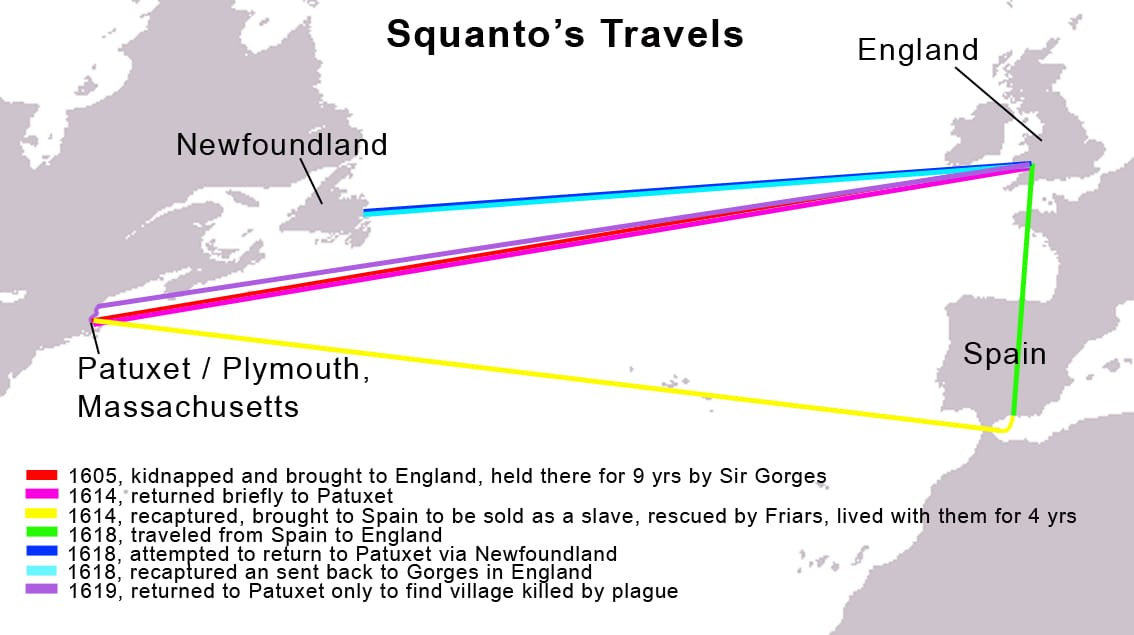
About six years before, Thomas Hunt, captain of a ship in John Smith’s expedition, decided to enhance his lucrative haul of dried fish by adding human beings to his cargo. He lured Tisquantum and other Patuxet tribe members aboard the ship with the promise of trade, kidnapped them, and sold them into slavery in Spain. Spanish monks bought Tisquantum and other captives; the monks apparently made some effort to educate them and convert them to Christianity.
The Indians hear with Patience the Truths of the Gospel explained to them, and give their usual Tokens of Assent and Approbation: you would think they were convinced. No such Matter. It is mere Civility. —Ben Franklin’s bitingly satirical “Remarks Concerning the Savages of North America”
Tisquantum never stopped trying to get back home. Somehow, he made his way to London. I imagine him wandering noisy, sooty cobblestone streets in that strange land, his thinking heart pounding in his chest as he tried to reconcile the two worlds and get back to his own. Eventually, he secured passage on an expedition back to North America with an explorer named Thomas Dermer. In Newfoundland, Tisquantum persuaded Dermer that New England was the best place to seek his fortune.
They sailed down the coast to Massachusetts Bay. However, Tisquantum’s long-awaited homecoming was pure tragedy: his entire tribe had been wiped out by an epidemic brought by the English. He was the last Patuxet alive. To add injustice to grief, Pilgrims were squatting on the conveniently cleared land of his lost community. Patuxet had become Plymouth.
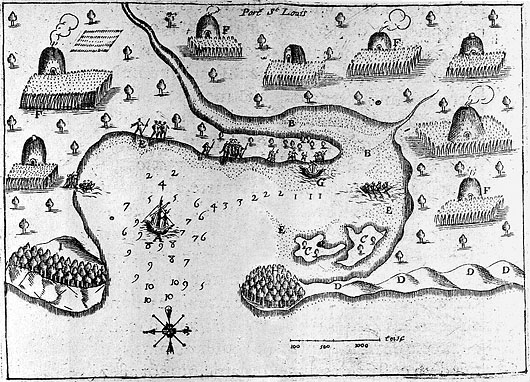
Though he had powerful reasons to hate the English, Tisquantum later would stand up for his fellow traveler Dermer against the Wampanoag, “People of the First Light,” whose initial friendliness to the settlers unsurprisingly had transformed to “inveterate malice.” Not only had the Wampanoag also been decimated by a boat-borne disease, but a white trader had lured a group of them aboard a ship and mercilessly slaughtered them. To them, all English were to blame; Tisquantum knew that his friend was not.
After unsuccessfully trying to save Dermer—the Englishman would get away but later die of his wounds—Tisquantum went to live with the Wampanoag. Then he stepped forward to mediate peace between them and the Pilgrims. He told the Wampanoag of the wonders he had seen in London; he warned them what was coming from across the sea and convinced them there was no stopping it. Instead, they would have to adapt to survive. Decimated as they were, and facing war with their enemies the Naragansett, they followed Tisquantum’s advice and forged a pragmatic partnership with the Pilgrims.
I have mixed feelings about this story, knowing what was coming. But as a man of vision, Tisquantum chose the best option based on his glimpse of the future. He kept everyone alive as long as he could by building bridges and brokering peace.
It's how you make peace when every single option for peace is absolutely not what you want. —Caroline Myss
In school we learned about Tisquantum as the half-mythical Squanto, the “Noble Savage” who taught the ill-prepared Pilgrims how to fish, hunt, and plant corn with fish heads. He plays a major role in the mostly mythical traditional Thanksgiving story, but the path of his life as a whole is more compelling than any cameo. When forcibly dragged out of his element, he adapted, improvised, and endured. Did he forgive? Nobody knows. We only know that he chose not to repay wounds with wounds in the face of inevitable change.
So who exemplifies the hero’s journey more: Odysseus, who took the long way home, won a war with a trick horse and arrived home just in time to slaughter his wife’s suitors and make servant women clean up the mess; or Tisquantum, who lost everything but still chose life—who eschewed revenge and wielded his powers of language and diplomacy to save lives?
Happy Thanksgiving, and thanks for reading.
Dillard, Annie. Teaching a Stone to Talk: Expeditions and Encounters. United States, HarperCollins, 2009. ↩