Rereading Charlotte's Web as Charlotte
Thoughts on International Women's Day


“Now for the R! Up we go! Attach! Descend! Pay out line! Whoa! Attach! Good! Up you go! Repeat! Attach! Descend…”
—word weaver Charlotte in Charlotte’s Web
It’s International Women’s Day, and along with many remarkable real women in the world, I’m thinking of an imaginary spider named Charlotte. She helped make me who I am. Her author was male, but with great literature that sort of distinction doesn’t much matter.
Age brings a multi-layered kind of knowing: I feel sedimentary, but in a fluid, semi-transparent way, as if I were looking out at life through gossamer weavings. When I look backward, among other things I see beloved books stained with cinnamon butter and Vicks Vap-o-Rub through seemingly endless childhood illnesses. In the quiet tedium of my sickbed, those stories were medicine, and I’ve never forgotten them.
I never tire of rereading favorite adult novels like Virginia Woolf’s To the Lighthouse; I find something new in them each time. The older I get, though, the farther back I want to go. It’s time to revisit those classic children’s stories: Margery Williams’ The Velveteen Rabbit, Joan Aiken’s The Wolves of Willoughby Chase (which I wrote about last year), Madeleine L’Engle’s Time Quintet, and now E.B. White’s Charlotte’s Web.
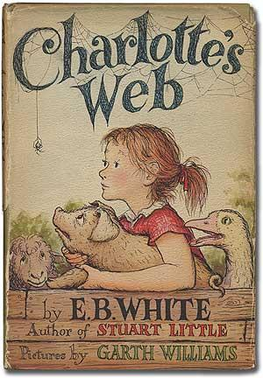
Actually, I bought a copy of Charlotte’s Web to give to the children of friends who are new Americans, but then I decided I’d better hold onto it for a while. I don’t worry about their English fluency; the eight-year-old girl is already a skilled and voracious reader. But Charlotte’s Web is hard on the heart, and they’ve so recently lived through such painful losses. So for my birthday month, I reread it myself. (With that dab of tomato sauce from my lunch in the corner, I’ll have to buy another copy.)
White’s classic has everything in it: growing up, growing old, making art, facing death, and making a difference in this heartbreaking but beautiful world. He published the book in 1952, just seven years after the end of World War II. That timing adds (for me) special poignance to a deceptively simple story set on the kind of family farm that scarcely exists anymore. There’s drama enough in a young pig named Wilbur who loves his life and doesn’t want to become bacon; the arachnid friend who decides to save him; and the human girl who is still young enough to understand animals and reject cruelty. But this little book also wrestles with the Big Mystery of suffering. White never lets us forget that even the wise, benevolent Charlotte must trap and kill bugs for her food, and that Templeton the rat wouldn’t lift a paw to help anyone if there weren’t something in it for him. (Personally, I wish writers would stop projecting human perfidy onto rats—we owe a debt of gratitude to the scavengers of the planet. But that’s another subject.)
Most of all, I think, Charlotte’s Web is a story about the power of words and friendship. With Templeton’s grudging help, Charlotte saves Wilbur by weaving words in the center of her web in the doorway above him, words that make him seem too special to kill: SOME PIG, TERRIFIC, RADIANT, and HUMBLE. White’s descriptions of Charlotte’s work are a tribute to the writer’s craft. She is doing what she is best at, what she loves to do; she just needs a little help with the spelling.
What’s funny is how right she (or White) is about human gullibility. Farmer Zuckerman sees “SOME PIG!” and immediately draws the conclusion that they have an extraordinary pig, as announced by a sign from above. Mrs. Zuckerman more sensibly suggests that they have an extraordinary spider, but she is overruled.
Because Wilbur is actually an ordinary pig, his porcine nature itself becomes something to celebrate. Moreover, the woven words make him feel and act special. That’s one of the gifts Charlotte gives him: making him a better person by describing him through the eyes of her fondness. The judges of the county fair concur that he is “some pig.” They give Wilbur a medal for his terrific radiance, and his fame ensures his survival.
We can make a difference with our words, too, even if nobody ever knows or remembers why things turned out better than they might have. In real life, our impact may never be clear; yet we still can send our words out into the world on faith, to sail like tiny balloon-webs on the air and land wherever the wind takes them.
Charlotte’s Web is hard on my heart in a different way now than it was in childhood. Now in my 50s, as White was when he wrote the story, I naturally empathize more with Charlotte than Wilbur. I see that her tasks required the wisdom and skill of age. At the end I don’t go back to the farm right away with Wilbur, the egg sac with her precious babies held in his mouth for safekeeping; instead I linger in the deserted fairground with dying Charlotte. The story says the little grey spider is alone at the end, but she is not: we are right there with her, in reverent silence.
Charlotte is still my hero.