Two Cranes at the Beach

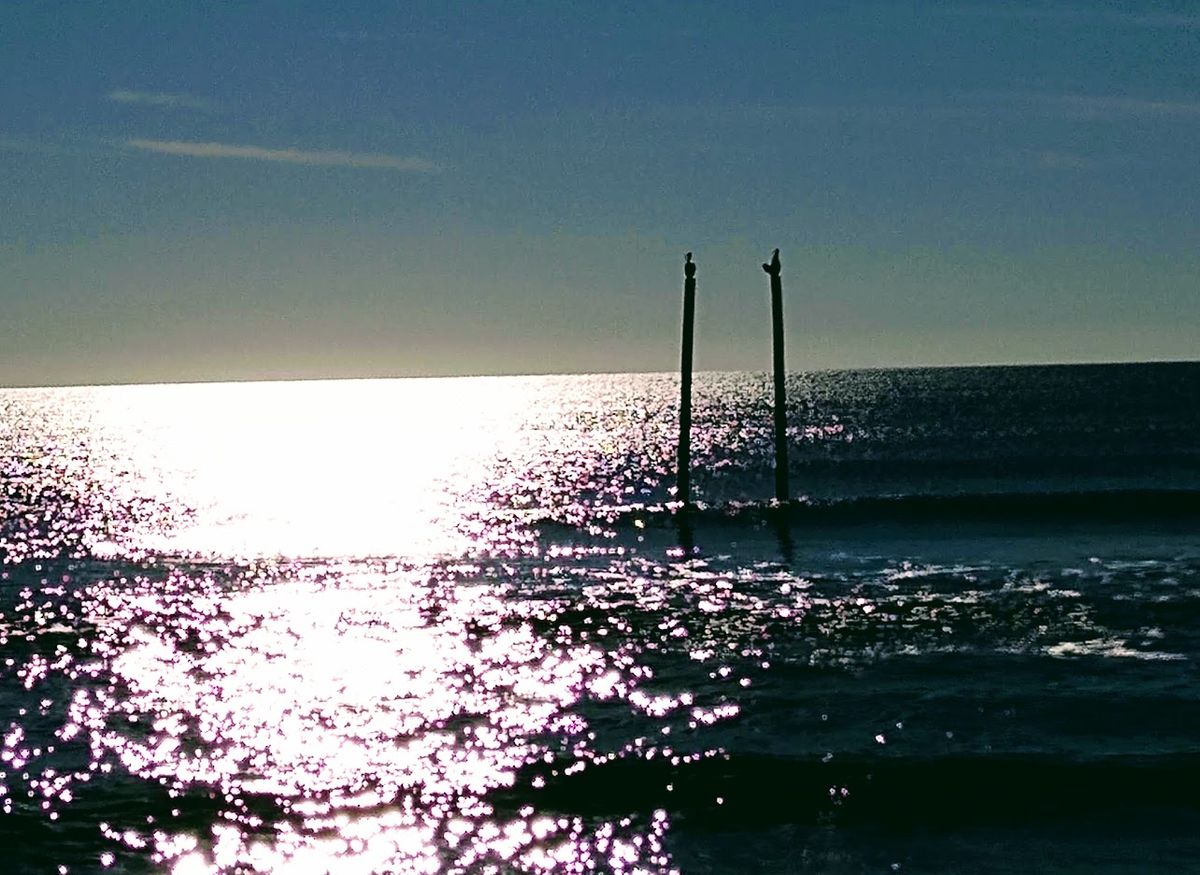
Shussssh. Shusssh-SHUSSSSH-shusssshhh. Ssssssssh. The rhythm is endless yet different every time: that’s the part that’s easy to forget when I’m far from shore.
My friend Paul and I drove a long way to stand here at the hurricane-frayed hem of North Carolina and watch the becalmed waves. My electric car labored up hills and then coasted giddily down, hopping from charger to charger until it reached Paul’s home halfway to the beach. Then he drove us the rest of the way.
Middle-aged sojourners on a budget, we’d found an All Halloween Summer beach rental in which we each had our own bedroom and bathroom. But I wouldn’t have minded cramped quarters. Sand between my toes was a pleasure I’d been long without, so I felt deeply grateful for this weekend away.
Along with the sand, surf, and sunshine, I got to enjoy the easygoing and familiar company of an old friend, a fellow reader and writer. I’d missed that, too. As we took beach walks and hunted for shells, lines from T.S. Eliot’s “The Love Song of J. Prufrock” kept popping into my head.
I grow old ... I grow old ...
I shall wear the bottoms of my trousers rolled.
Shall I part my hair behind? Do I dare to eat a peach?
I shall wear white flannel trousers, and walk upon the beach.
Prufrock fears that instead of finding the courage to “force the moment to its crisis,” he’ll just grow quietly old. Paralyzed with indecision, he’ll smother his longings and shrink to nothing, and mermaids will never sing to him. To young Thomas Stearns, 22 years old in 1910, reaching old age without sounding one’s barbaric yawp across drawing rooms must have seemed like a terrible fate.
I should have been a pair of ragged claws
Scuttling across the floors of silent seas.
Those two lines used to make my hair stand on end. I would reread the poem just to get to them. Hunched on my twin dorm bed, I’d sink to the bottom of the ocean and let the water wash away my half-baked civility, my doubts and fears. I’d snap my giant claws as I scuttled away.
I’ve swum in deep waters and nearly drowned. I’ve felt “blood shaking my heart/The awful daring of a moment’s surrender/Which an age of prudence can never retract” (The Waste Land).
In my 50s, I have no regrets, but I no longer wish I were a crab. I’d like a nice crab salad, maybe, on a bed of lettuce, and a table on the patio with a bit of shade.
It just occurred to me that T.S. Eliot’s wife was the wild, instinctive thing Prufrock yearned to be—in the cruel words of Virginia Woolf, she was a “bag of ferrets around Tom’s neck.” He fled from Vivienne’s feral intensity and left no forwarding address. Claws should scuttle discreetly, apparently, and not snap at literary men’s noses and draw blood. But anyway…
Paul and I were a couple a long time ago. Now we’re friends. There’s no “just”; I experience our long friendship as real and complete. We’ve known each other through the deaths of both of my parents and his father, through struggles with unfinished novels. There is no room in Modernist poetry for our chill beach weekend, maybe because the Modernists tended not to live long enough to appreciate this kind of fun.
We grow old…we grow old…we shall wear the bottoms of our trousers rolled. But then we’ll wade in farther and get our butts wet anyway. Whee!
Do we dare to eat peach cobbler that got a bad Yelp review? Hell, yeah. It definitely needed more fruit, less gummy bread, but dessert is dessert.
As we walked the shore at night, the tide washed up jellyfish and two more long-dead American literary men: a Naturalist and a Modernist who shared a last name.
Dodging the garrottes of nearly invisible fishing lines, Paul and I talked about Stephen and Hart Crane. I confessed that I often mixed them up, though their styles couldn’t be more different.
“I tried to read Hart Crane’s poetry and found it…difficult,” Paul said.
“Me too,” I said. “It’s…convoluted? obscure? difficult,” I settled back on. “I like Stephen Crane’s direct language better.”
Though Stephen is best known for The Red Badge of Courage, I was thinking of his hauntingly realistic short stories. He often set the natural world in stark contrast to human suffering and struggle.

This passage is from “The Open Boat,” a story based on the author’s experience of floating adrift in a dinghy with other men after the sinking of their ship off the coast of Florida:
Canton flannel gulls flew near and far. Sometimes they sat down on the sea, near patches of brown seaweed that rolled on the waves with a movement like carpets on a line in a gale. The birds sat comfortably in groups, and they were envied by some in the dinghy, for the wrath of the sea was no more to them than it was to a covey of prairie chickens a thousand miles inland. Often they came very close and stared at the men with black bead-like eyes.
For stylistic contrast, here is Hart Crane’s poem “The Air Plant”:
Grand Cayman
This tuft that thrives on saline nothingness,
Inverted octopus with heavenward arms
Thrust parching from a palm-bole hard by the cove⎯
A bird almost⎯of almost bird alarms,
Is pulmonary to the wind that jars
Its tentacles, horrific in their lurch.
The lizard’s throat, held bloated for a fly,
Balloons but warily from this throbbing perch.
The needles and hack-saws of cactus bleed
A milk of earth when stricken off the stalk;
But this,⎯defenseless, thornless, sheds no blood,
Almost no shadow⎯but the air’s thin talk.
Angelic Dynamo! Ventriloquist of the Blue!
While beachward creeps the shark-swept Spanish Main
By what conjunctions do the winds appoint
Its apotheosis, at last⎯the hurricane!
Stephen takes us directly into the scene where gulls stare at us with their beady eyes—where actual claws scuttle beneath the bottom of our tiny, leaking boat. Brilliant Hart, on the other hand, goes so deep into metaphor upon implied metaphor that I struggle to stay grounded. I’m no air plant, especially not at this age.
Does it seem unfair to compare prose to poetry? Here is Stephen’s poem “In the Desert”:
In the desert I saw a creature, naked, bestial,
Who, squatting upon the ground,
Held his heart in his hands,
And ate of it.
I said, “Is it good, friend?”
“It is bitter—bitter,” he answered;
“But I like it
“Because it is bitter,
“And because it is my heart.”
I’ve gnawed on my own bitter heart. Now I can envy the air plant sailing unharmed on hurricane winds. I’m sorry, Hart. Now I get it.
“Hart Crane died at sea, you know,” Paul said. “He jumped off a ship in the Gulf of Mexico. He was gay, and he had gotten beaten up for approaching a sailor.”
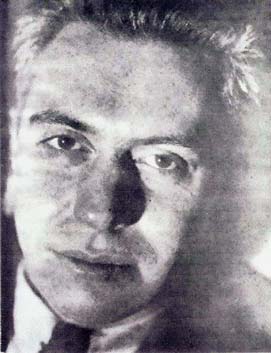
I hadn’t known. Looking out across the vast, moonlit ocean, I felt sad and humbled.
How would Stephen have described the night when battered, drunken 33-year-old Hart called out “Goodbye, Everybody!” and threw himself overboard? Stephen had courted scandal in his own life by trying to protect a young woman from arrest as a prostitute; he also was the common-law husband of a woman who ran a bordello. Cora would become the U.S.’s second female war correspondent. I like to think Stephen would have extended his clear-eyed empathy to his namesake.
“And then there’s Ichabod Crane,” Paul said, smiling his mischievous smile.
We are no great scholars, nor were meant to be. Just two friends at the beach.
Our last morning, we ate leftover cobbler for breakfast. With the shuuusssh of the waves as background through an open balcony door, we watched the end of The Center Will Not Hold, a documentary about Joan Didion. I hadn’t known that she’d lost her daughter so soon after husband, and that she’d written about that loss, too, in Blue Nights. Was she brave to document her grief, like a war correspondent? Or was the writing sheer necessity? I think both.
In my 50s, what I want to know is how to enjoy myself, as myself. At the same time, I need to know how to float in an open boat through storms of loss. How we all might stay afloat together, riding the waves and holding each other steady. I always come back to the grace of long friendships.