Wishes, Lies, and Dreams

Here is a list of five things I did last week to validate my proverbial parking space on earth. Just kidding; I’d rather share some books.
Modern Masters for children: was that a good idea?
Happy Birthday, [xx] year old!
When my sister typed that line in a chat on our younger brother’s birthday, it was funny not just because we’re all well past 50, but because we all got the allusion to John Ciardi’s The Wish Tree. It was a large blue hardcover book that Tracy had won at a birthday party. Over the years it passed through all our grimy, crayon-scribbling hands, affecting some of us more deeply than others.
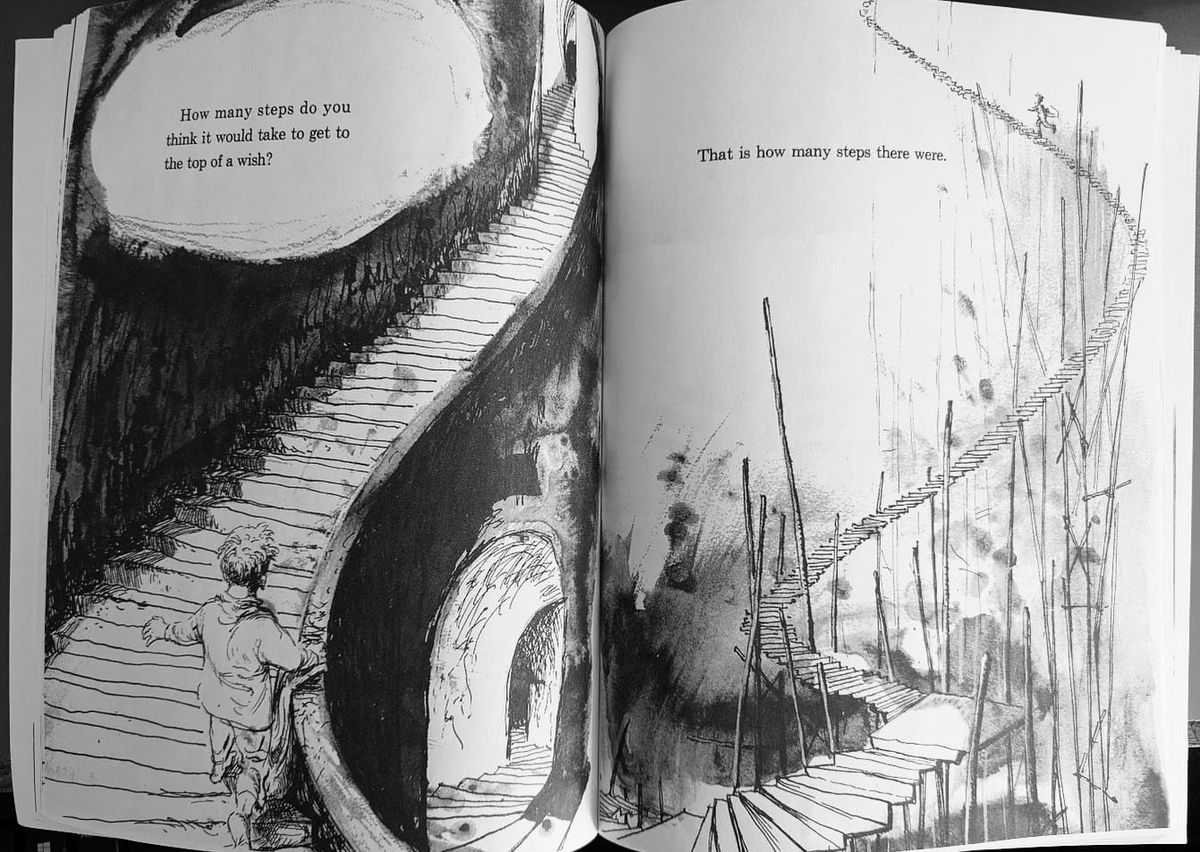
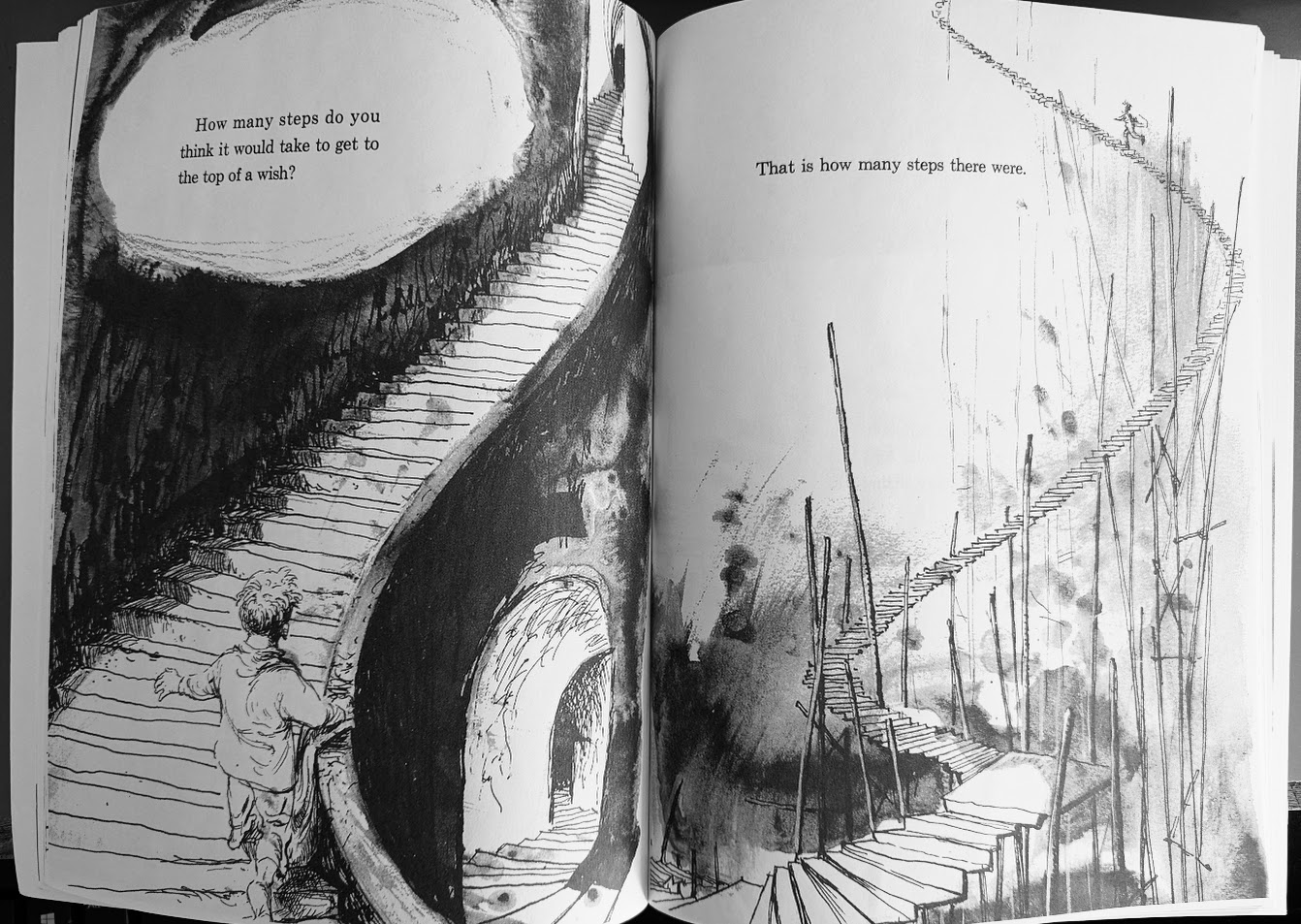
The Wish Tree is not a funny book; it’s a wondrous and haunting one. It was part of a Modern Masters series by Crowell-Collier Press, the idea being to get famous writers to pen an impactful children’s story. In hindsight, maybe they shouldn’t have approached Ciardi so soon after his translation of Dante’s Purgatorio. He turned a story about a little boy who wants a puppy into a work of great symbolic intensity, essentially placing the arduous path up Mt. Purgatory inside a giant dream-tree. But really, it’s Louis Glanzman’s ink-and-charcoal illustrations that take the story to another level.
It’s the night before the boy’s sixth birthday. To make a true wish, according to his father, he first has to find a wish tree and then decipher the mysterious word cut into its trunk:
TAKECAREOFYOURWISH
But how? Start climbing. The path to understanding is up and up the winding stairs. The stakes are high, and if you’re not responsible and vigilant, you may do harm to your wish without meaning to or realizing it. To make sure you get the message, here’s a giant crow to squawk it at you. Go up one more flight!
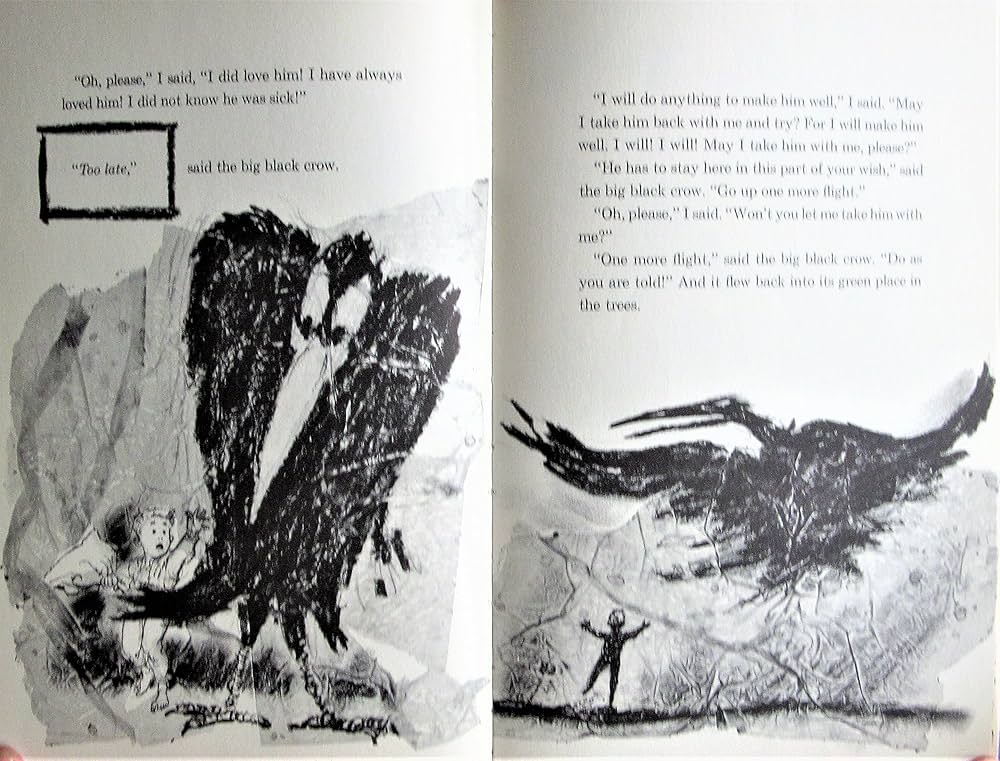
The thing is, the boy learns, there is never any top to a wish. For now he just wants his puppy, and he’s ready to take care of him.
He wakes up to “Happy Birthday, Six-Year-Old!” and a “high-little, glad-little, funny-little puppy bark,” but I feel as if part of me is still on those stairs, climbing and climbing.
Curious, I looked to see which other famous authors had written Modern Masters books for the edification of children. Oh look, they got Shirley Jackson, fresh from writing The Haunting of Hill House! Half appalled, I ordered a copy.
Jackson’s story is about wishes, too, but to my relief, it’s a light, playful story. In 9 Magic Wishes, a child encounters a magician who offers her said wishes. Each of her wishes is more fanciful than the last: an orange pony with a purple tail; a silver sky ship with red sails; a tiny zoo to hold in her pocket. Most interesting, she stops at eight wishes because she already has all she wants. Then, instead of hoarding it for himself, the magician sets the last wish in a box on a rock for someone else to find.
TAKECAREOFYOURDEMOCRACY
It feels jarring to turn from children’s books to the grimmest of grownup stories, The Rise and Fall of the Third Reich. But that’s where my reading went.
Chapter 7, “The Nazification of Germany,” tells how German politicians and then the public willingly relinquished their struggling democratic republic to Hitler, believing his lies and false promises. That turning point, when things still could have gone another way, is hard to read about now.
So I set aside Chapter 7. I needed a movie to peddle an elliptical machine in front of, preferably something with a happy ending. Star Trek IX: Insurrection did the trick.
Star Trek is comforting because you instantly know who the villains are: in this case, a bull-necked, shifty-eyed Federation admiral and an alien F. Murray Abraham with his skin stapled to his head. When Picard uncovers a conspiracy to displace a people and destroy their planet for its coveted resources (particles that grant eternal youth), he is told that it’s all perfectly legal and according to orders. He barks the right question as usual: How can there be an order to abandon the Prime Directive? How, indeed? The admiral learns a nasty lesson about collaborating with thugs, and Picard falls for a 300-year-old woman who doesn’t look a day over 35.
Flashes of Truth and Beauty
For Friday night bedtime reading, I found solace in a YA classic: Emily of New Moon by Lucy Maud Montgomery, author of the Anne of Green Gables series. In this semi-autobiographical story, an orphaned girl stays true to her imaginative, spontaneous nature in defiance of a dour aunt, a cruel teacher, and other forces trying to squelch her spirit.
I felt moved by Emily’s spirituality, the way ordinary life yields to “flashes” of something more vivid and real for her. The sense of a loving, living God—one that she’d shared with her father—contrasts with her guardian aunt’s grim sense of duty and respectability. The aunt is not really a villain, though; it’s more that she and Emily are incapable of “getting” each other. The teacher, on the other hand, is just plain evil.
There’s room for the teaching of self-discipline and responsibility, and there’s room for the celebration of imagination and spirit. But there’s no room for cruelty in the guise of correctness, efficiency, morality, or anything else. On that I think every writer I read last week would agree.
It’s my birthday soon; maybe I’ll find a wish tree of my own. I’ll wish big and climb as high as I can.