Thriving in New Soil: French Pancakes in Parish
by
Janet Carty
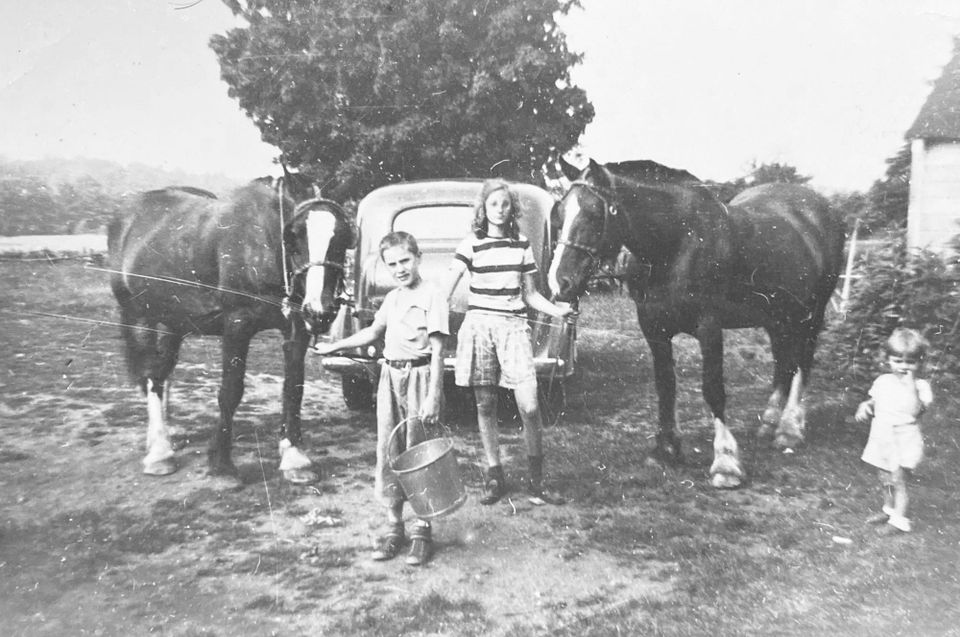
Note from Jody: Tolstoy’s Anna Karenina famously begins, “Happy families are all alike; every unhappy family is unhappy in its own way.” That may have been true in 19th-century Russia, but it’s never made much sense to me here in America. Maybe that's because in my first year of college, I met a family who seemed uniquely happy. My new friend Janet Carty’s tribe had suffered tragedy—if happiness were contingent on nothing bad ever happening to us, we’d all be doomed—but they laughed easily and cussed each other cheerfully. The Cartys became a second family to me through college and beyond, a stroke of luck that I give thanks for. So I’m delighted to publish Janet’s story of her mother Jean’s roots and one of the family recipes that graced their dinner table, where Southern and Yankee cultures converged along with every topic under the sun.
The town of Parish in western New York was founded by one of my ancestors, Thomas Nutting, in 1803, when that part of the state was still frontier and heavily forested. My mother, Jean, grew up in Parish in the 1930s, on what by then was the old family farm. Following one grave stone to another back through time, I’m stunned by how many of my mother’s predecessors (my predecessors) were born, lived, and died all within the confines of Oswego County, on the banks of Lake Ontario, a mere 80 miles south of Canada.
One of the many family legends that my mother handed down was that we were descended from French nobility. In her story, a branch of our family had fled the French Revolution, arriving in western NY to rebuild a life on American soil. I always listened to this tale with Grand Skepticism, but research revealed that in the early 1800s, many European refugees fled the Napoleonic Wars and did in fact settle as a group a scant seven miles from Parish in a town named—oddly, delightfully—Mexico. One of the main roads leading from Mexico to Parish is called French Street.
Perhaps the family legend wasn’t that far off.
Last week I called my older sister, the only member of my family that I knew to have taken a DNA test. To my surprise, she confirmed a genetic link to southern France. Mon Dieu.
My mom always asserted that the French government eventually reached out to the displaced nobles to offer reparations—with the coda that they had to return to France to claim their lands. At least our branch of the family refused, proclaiming they were Americans now. Farmers. Their French roots were strong, but they had transplanted themselves; they would thrive in new soil.
A decade before she passed at the age of 91, my mother bowed to the pressure of her many children and compiled a cookbook of family recipes, titled Jean’s Old Family FLavorites. Included within this collection are recipes handed down from my mother’s Northern relatives and my father’s Southern tribe. Hence, Uncle Ralph’s Cornbread (Southern) is found just opposite Aunt Lucy’s Date Nut Bread (Northern). My mom was raised by her aunt, so Aunt Lucy was also Mom to her.
I’m still highly skeptical of my mother’s nobility claim, but the confirmation of our ancestral connection to France explains the inclusion of one of my favorite recipes in the family cookbook: French Pancakes. We ate them all the time as children, generally for dinner, mostly in winter. Standing at the stove of our Southern home in the Blue Ridge Mountains of Virginia, Mom would spread the batter so thinly over the old iron skillet that they were almost translucent—they cooked in moments, and flipping them took delicate skill. She would hand them to us one at a time, (five of us kids waiting with plates in hand) and we stacked them, layered them with butter and cinnamon and sugar, just like regular American pancakes. Occasionally, we would roll them, but the fillings remained the same.
I was almost twenty before I realized that the thin, delicate pancakes we had grown up eating and loving and drowning in maple syrup were, in fact, crepes.
The following is a very basic family recipe which assumes some familiarity with the crepe-making process. I have found that the flour likes to clump, so when it says to beat well, it really is important. Also, this is a much more egg-heavy crepe recipe than Julia Child’s recipe, which has a greater ratio of milk and water to fewer eggs. But to me, it tastes like home. Bonne chance et bon appétit.
Jean's French Pancakes
For 4 to 6 servings
Ingredients
- 6 eggs
- 2 TBSP plain flour
- ¼ cup milk
- 1 tsp vanilla
- nutmeg
Instructions
- Beat the eggs well.
- Add the flour and milk. Beat well, again.
- Stir in vanilla and a sprinkle of nutmeg.
- Heat a cast-iron frypan over medium heat. (If it's not well seasoned, use a bit of butter to prevent sticking.) Pour the batter by the Tablespoon onto the frypan, usually 2 TBSP per pancake. Tip the pan back and forth to spread the batter very thinly over the pan. Only do one pancake at a time and spread the batter as thin as possible. It should just about cover the pan. Fry for about 1 minute on each side.
- Serve with powdered sugar and/or honey or syrup.
Member discussion