In Defense of Gruel
It's such an odd little word: short but drawn out, comical yet faintly sinister.

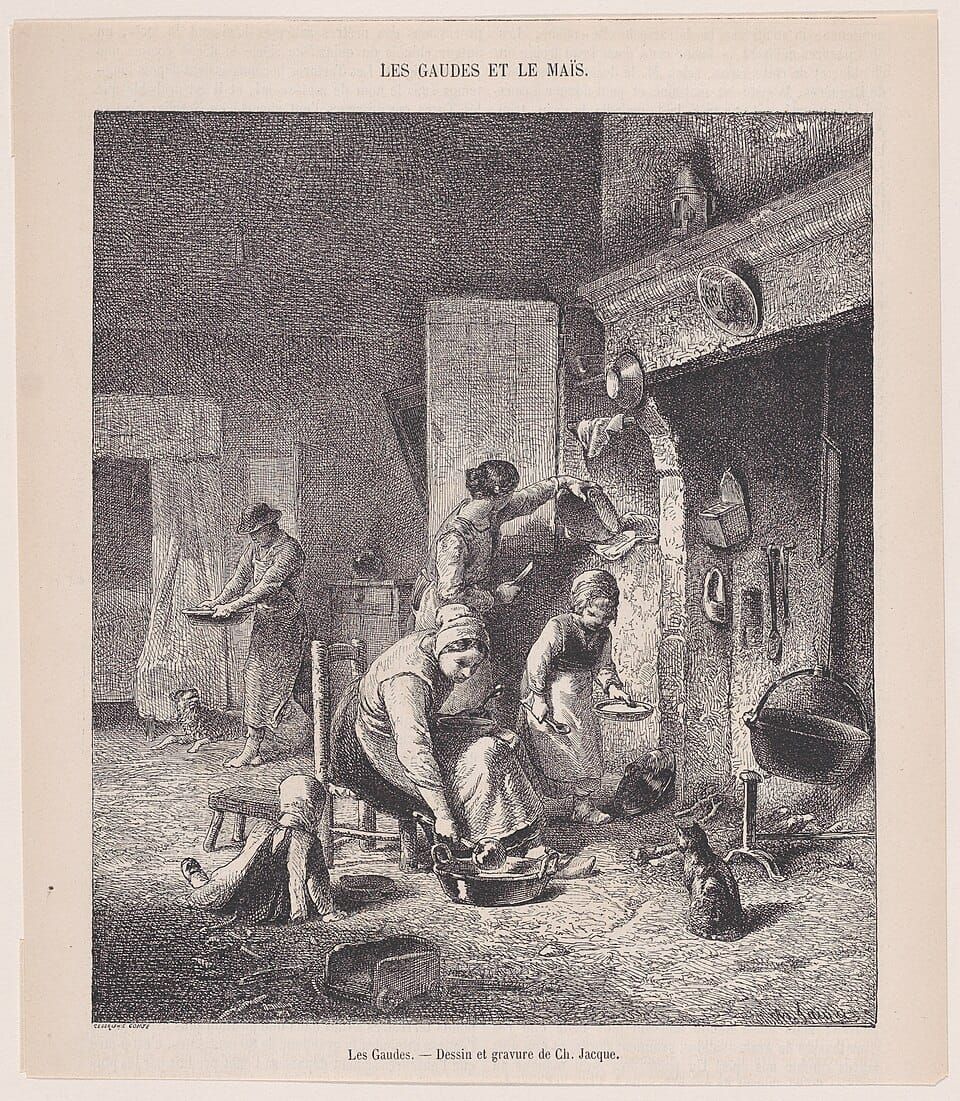
1. A fluid or semi-liquid food, usually for infants or invalids, made by boiling meal or any farinaceous substance in water. Hence any pasty mess.
2. To exhaust; use up; disable.
It's such an odd little word: short but drawn out, comical yet faintly sinister. Though it entered Middle English by way of French, its origins are Germanic. Its obsolete verb form, which gave us grueling, means "to punish."1
Soupy porridge is a punishment, isn't it? Yet before Oliver Twist asked for more, Jane Austen's Mr. Woodhouse was spooning it up from fine china in a well-appointed drawing room. In Regency England, wealthy hypochondriacs and real invalids sipped gruel (sometimes with a splash of brandy) for its purported health benefits. So when Mr. Woodhouse says, "suppose we all have a little gruel," he isn't just pushing a dull bedtime snack—he means to save his companions' lives. More to the point, like anybody with a stubborn fixation, he needs to grab people by the collar and make them grasp how IMPORTANT it is.
Like much of Austen's understated wit, Mr. Woodhouse's gruel made me snort out loud when I read Emma decades ago. I could hear him intoning the word with lugubrious relish: GROO-el. What's funny now, though, is that it turns out I was laughing at my future self.
Yep, now that I'm now closer in age to Austen's gouty elders than her limpid heroines, I'm all about the gruel. Spooning up mush is still not my idea of a good time, but I eat an oatmeal-seed mixture thinned with almond milk almost every morning like medicine now (an hour after my thyroid pill). I'm even writing a post to recommend it! C'mon, y'all, let's have some gruel.
Just as an ordinary word can start to sound exotic if you repeat it enough times, a simple object of sustained attention can reveal its hidden shine. Gruel, I just read, is one of the most ancient and important of human foods. Long before farming, people would gather wild grains, soak them in water, and heat them over a fire to make them easier to digest. As a medium for yeast to grow, gruel was also the first step toward bread and beer. Most ancient Greeks and Romans subsisted mainly on boiled grains, as bread was a luxury requiring access to ovens. Likewise, here in the Americas, corn gruel was a staple food of the Maya and Aztecs.
I'm no food historian, though: mostly, gruel reminds me of my childhood. Countless memories have floated away like dandelion puffs, but I still remember eating brown-sugar oatmeal and soupy cream of wheat in our New England kitchen on winter mornings. The porridge would warm me from inside as I waited for the schoolbus at the end of our driveway, my breath freezing in front of me.
Why do I still remember those bowls of oatmeal (and a creepy doll that go-go danced with batteries in her belly)? Probably because they are tucked up against trauma circuits of my brain—in this case, the trauma of school. Weird as it may seem for somebody who works on educational materials, school terrified me at first. My heart would race as the yellow bus squealed to a stop and its narrow doors creaked open, the stout driver cranking the lever with her fist. That folding door was the portal to a harshly regimented world in which I was neither known nor dear. I boarded the bus with a sure sense of my own importance but exited as a chubby, nearsighted kid whose mom hemmed her dresses too short. Home had its own perils, for sure, but to borrow from the poet Rilke: school offers us, "in exchange for difficulties in which [we] are practiced and experienced, other difficulties that find [us] perhaps even more bewildered."2 I was more bewildered.
Eventually—it probably only took a week—I learned the routine, made friends, and got a crush on a little boy with the whitest-blonde hair I'd ever seen. But school mornings still felt as if I were being frog-marched to the gulag. So that bowl of hot porridge wasn't just breakfast—it was emotional ballast.
Half a century later, I've given up on trendy keto diets and rediscovered the humble gifts of gruel. It comforts and grounds me before I go about my work in the world. It's also, as we used to say up north, wicked good at lowering cholesterol.
Steel-Cut Oats with Flax and Chia Seeds
This recipes serves 2-3, just in case you convince somebody to join you.
Ingredients
- 1 cup steel-cut oats (also called Irish oatmeal)
- 3 cups water
- 1 cup milk (I use almond milk)
- 2 tablespoons chia seeds
- 2 tablespoons ground flax seeds
- 1 finely chopped apple for sweetness and extra soluble fiber
Instructions
I make this in an Instant Pot, setting it on Porridge and then wandering off with my coffee. It takes about 35 minutes total to warm up, cook, and then sit for 10 minutes before you release the remaining steam. You could simmer the oats on the stove in about the same time, stirring them periodically.
Cook the oats in the water. Spoon oatmeal into bowls and then add milk, chia and ground flax seeds, and optional chopped apple. Stir well. Let rest for a few minutes to allow the chia seeds to soak up the liquid.
To keep flax from going rancid, I store the whole seeds in the fridge and grind up small amounts in a coffee grinder.
1 In case you wanna hop down the same rabbit hole I did, here are more words that launched in English in the 14th century, including launch.
2 Rilke, Rainer Maria, and Robert Hass. The Selected Poetry of Rainer Maria Rilke. Translated by Stephen Mitchell, Vintage Books, 1984.